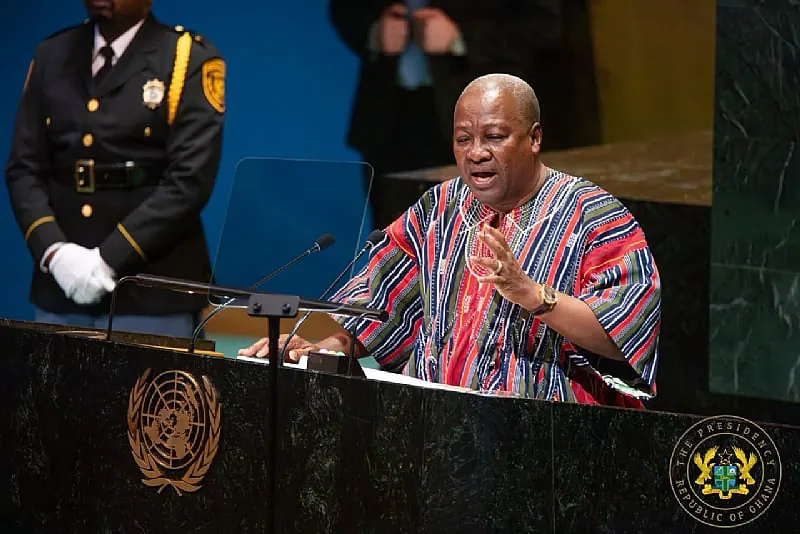
President John Dramani Mahama of Ghana has faced criticism for his recent justification for not declaring a state of emergency on illegal mining, popularly known as galamsey. In a circulating video, Mahama argued that he never promised to declare a state of emergency, that it should be a last resort, and that galamsey's presence in ten regions makes it impractical to declare a state of emergency everywhere. Critics have described his argument as weak and insulting to Ghanaians witnessing the destruction of their water bodies and forest reserves.
The critic, Abdulai Abdul-Razak, described Mahama's argument as flawed. He pointed out that galamsey itself is already a state of emergency, with Ghana's water bodies poisoned, cocoa farms destroyed, and babies born with deformities in mining areas. The critic argued that the Constitution allows a state of emergency to protect the nation's existence and that galamsey poses an existential threat to Ghana's water, food security, and future.
The critic also challenged Mahama's claim that a state of emergency would infringe on people's rights. Mahama stated that a state of emergency would allow people to be arrested without question and detained without the 48-hour rule. However, the critic countered that galamsey operators are already operating outside the law, armed, and pose a threat to forest guards. The critic questioned whose rights are being protected - those of armed criminals or those of law-abiding citizens seeking a safe environment.
Furthermore, the critic argued that the current strategy of clearing red-zone forest reserves and deploying the army has failed. Despite efforts to curb galamsey, the problem persists, and the turbidity levels of Ghana's water treatment plants continue to rise. The critic claimed that a state of emergency would not only involve soldiers but also halt small-scale mining, freeze excavator importation, and empower security services to take action without interference.
The critic also disputed Mahama's claim that a state of emergency would be impractical due to its presence in ten regions. The critic argued that the widespread nature of galamsey is precisely why a national state of emergency is needed. He emphasized that a state of emergency would send a clear message that there will be no sacred cows and that decisive action is necessary to address the issue.
In 2013, Mahama promised Ghanaians that he would fight galamsey to the end. However, critics argue that his administration's efforts have been insufficient, and that a state of emergency is necessary to address the scale and complexity of the problem. The critic urged Mahama to take bold action, rather than making excuses about human rights.
The issue of galamsey has significant implications for Ghana's environment, economy, and public health. With millions of Ghanaians relying on the affected water bodies and cocoa farms for their livelihoods, the need for effective action to address galamsey has become increasingly urgent. As the debate continues, it remains to be seen whether Mahama's administration will take decisive action to address the issue.
Key points
- Critics argue that President Mahama's justification for not declaring a state of emergency on galamsey is weak and insulting to Ghanaians.
- Galamsey poses an existential threat to Ghana's water, food security, and future, and a state of emergency may be necessary to protect the nation's existence.
- The current strategy to curb galamsey has failed, and a state of emergency could provide a more effective solution to the problem.