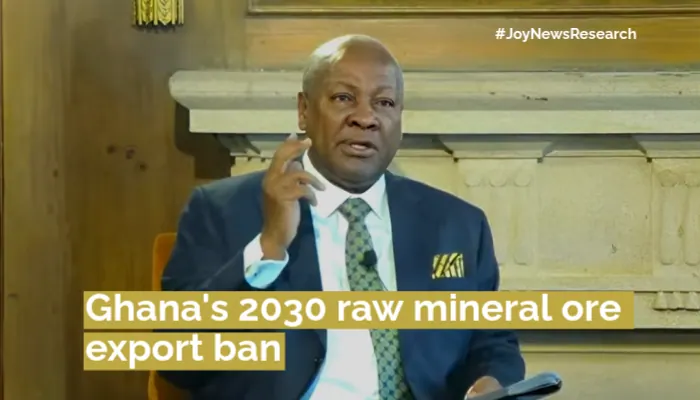
Ghanaian President John Mahama has reiterated his government's commitment to stopping the export of raw mineral ore by 2030. Speaking at the Council on Foreign Relations in New York, Mahama told mining companies to begin processing minerals locally, as new regulations take hold. The policy aims to retain more value from Ghana's natural resources. Mahama first announced the 2030 deadline in February.
Ghana is a significant producer of gold, bauxite, manganese, and diamonds, and is set to become a lithium producer. Mahama's government has introduced measures to increase local processing, including raising royalties and increasing the state's share of gold output. The government has also made local refining compulsory for some exports and taken a firmer approach to lease renewals. These changes have been implemented since Mahama returned to office in January 2025.
The 2030 deadline for the ban on raw mineral ore exports falls after Mahama's term ends in January 2029. As Mahama is barred from seeking re-election due to the constitution's two-term limit, enforcement of the ban will rest with his successor. While the ban has not yet been written into law, the Minerals and Mining Bill, laid before parliament on May 26, would allow the minister to prohibit the export of unprocessed or raw mineral concentrates.
Large-scale gold miners in Ghana already smelt ore into doré, a semi-pure alloy, before it leaves the mine site. However, manganese and bauxite are largely exported as ore and could be more directly affected by the ban. Since July 1, large-scale miners have been required to sell 30% of their output to the Ghana Gold Board in doré form, to be refined locally. This policy aims to increase local refining and reduce raw ore exports.
The Ghana Gold Board has signed agreements with Gold Coast Refinery and Royal Gold Refinery to process up to a tonne of gold a week. Since September 1, aggregators exporting artisanal gold have been barred from shipping unrefined doré, with exports approved only after the Gold Board confirms the metal was refined in Ghana. The board has reported that nearly nine tonnes of gold aggregated this year has been refined locally.
Small-scale gold output hit a record 104 tonnes in 2025, overtaking large-scale mining for the first time. The sector earned close to $11 billion in foreign exchange against about $9 billion from big miners. The government has also introduced a sliding-scale royalty, which took effect on March 9, replacing a flat rate of up to 5%. Gold miners pay 5% when bullion is at or below $1,900 an ounce, rising to 12% above $4,500.
The Ghana Chamber of Mines had proposed a narrower band of 4% to 8% for the royalty rate. Parliament cut the Growth and Sustainability Levy on miners from 3% to 1% in March, and the 2026 budget abolished the 15% value-added tax on mineral exploration and reconnaissance. The government has also taken a firmer approach to lease renewals, with the Minerals Commission chief stating that the process "won't be business as usual."
Key points
- President Mahama's government aims to stop exporting raw mineral ore by 2030.
- The policy aims to retain more value from Ghana's natural resources.
- The ban has not yet been written into law, but the Minerals and Mining Bill would allow the minister to prohibit the export of unprocessed or raw mineral concentrates.