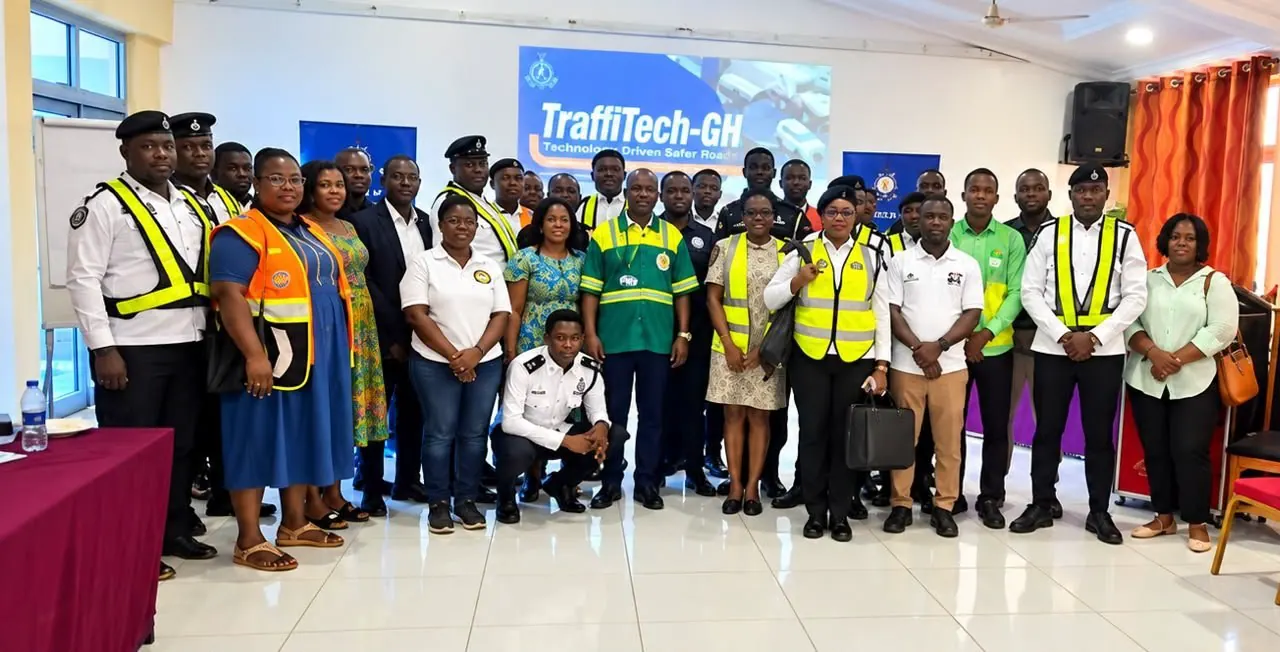
The Ghana Police Service has completed the final leg of nationwide training for officers who will process motorists' fines under the automated traffic enforcement system, Traffitech-GH. The training, which took place in Ho, Volta Region, was the fifth and final session and brought together 45 participants from various agencies, including the Motor Traffic and Transport Department (MTTD), the Judicial Service, and the National Road Safety Authority (NRSA). The training was designed to equip enforcement teams with practical skills to process traffic offences and fines once automated cameras begin catching violations.
The training covered the legal backbone of the new system, including the Road Traffic Regulations, 2026 (L.I. 2519) and the Road Traffic (Amendment) Act, 2025 (Act 1153). Participants were also taken through automated road traffic offences and fines under Regulation 242, an overview of how Traffitech-GH will function in practice, and the process motorists can follow if they wish to contest a violation flagged by the system. The training aimed to ensure a shared understanding of the rules governing automated enforcement.
A selected back-office team from the Volta Region received hands-on instruction in operating the in-vehicle fixed camera as well as the handheld or tripod-mounted Lasercam4 speed camera, the equipment expected to capture violations once the system is live. The Volta Regional back office has already been fitted with the updated Traffitech-GH software at the Regional MTTD Office in Ho, part of broader preparations to enforce Regulation 242 nationwide.
The Ho workshop was the last of five regional training sessions the Police Service and its private partner ran across the country in the run-up to the launch. Traffitech-GH is a camera-based system intended to automatically detect and penalise traffic offences without requiring an officer to flag down every violator in real time. The system is set to become operational nationwide on October 1, 2026.
From October 1, drivers across the country could begin receiving fines generated automatically by fixed or handheld cameras rather than through a traditional police stop. The training explicitly covered a "contest flow" for motorists who dispute a violation, suggesting a formal channel for challenging automated fines. However, the exact mechanics of that appeal process and any applicable fees have not been detailed.
The involvement of the National Insurance Commission (NIC) and the Driver and Vehicle Licensing Authority (DVLA) in the training suggests the new regime may tie into vehicle insurance and licensing records. However, the exact mechanics of that integration have not been spelled out in the available reporting. The MTTD, NRSA, NIC, and DVLA all played a role in the training, highlighting the collaborative effort behind the rollout of Traffitech-GH.
With the training complete and the system set to go live on October 1, 2026, motorists in Ghana can expect a new era of automated traffic enforcement. The system's rollout will bring significant changes to how traffic offences are detected and penalised, with far-reaching implications for road safety and traffic management in the country.
Key points
- The Ghana Police Service has completed nationwide training for the Traffitech-GH automated traffic enforcement system, which is set to become operational on October 1, 2026.
- The training covered the legal framework, automated road traffic offences, and the process for contesting violations.
- The system will use camera-based technology to automatically detect and penalise traffic offences, with motorists potentially receiving fines generated automatically by fixed or handheld cameras.