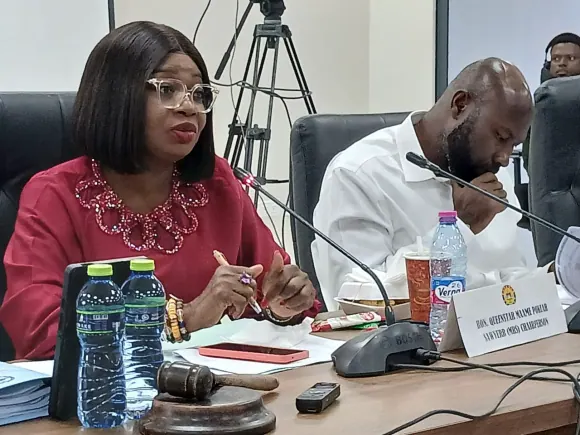
The Chairperson of the Parliamentary Committee on Local Government and Decentralisation, Queenstar Pokuah Sawyerr, has expressed concern over the huge number of unauthorised billboards and signboards along major roads in Accra, Ghana. She stated that these structures had become a disturbing menace, obstructing motorists' views and posing a threat to road safety. Mrs Sawyerr raised the issue when officials of the Accra Metropolitan Assembly (AMA) appeared before the committee on October 6 to respond to financial infractions contained in the 2025 Auditor-General's reports.
Mrs Sawyerr noted that one of the biggest challenges facing beautification and road safety in Accra was the presence of unauthorised billboards and signboards along major roads. She urged the AMA to focus on billboards and signboards mounted along road medians, saying some of them were positioned in ways that made it difficult for motorists to see clearly. The MP for Agona East said the situation had become a concern for motorists, with several complaints from people who had experienced difficulties driving around parts of Accra because of structures obstructing their views.
Mrs Sawyerr also urged the AMA not to focus mainly on petty traders using tables along the medians, but rather deal with containers and other permanent unauthorised structures in the streets. She argued that traders using tables were often the least of the assembly's problems, stressing that the presence of containers and other unauthorised structures created an environment that encouraged more people to occupy the road medians. Mrs Sawyerr added that the AMA should deal with the billboards and those putting up unauthorised signboards and structures without permission.
In response, the Chief Executive of the AMA, Michael Kpakpo Allotey, stated that the assembly had formed a team to assist in dealing with the challenge of unauthorised billboards and signboards. He said the AMA had already begun removing some unauthorised billboards and signboards within road medians and did not need to give notice to the owners since they did not have permission. Mr Allotey explained that attempts to notify owners of unauthorised structures before removing them often gave them the opportunity to mobilise people to resist the exercise.
Mr Allotey further explained that the assembly was taking steps to relocate traders from road medians as part of efforts to restore greenery and beautify major roads in the city. He said the assembly inherited a situation in which hawkers sold at several locations across the city and that the administration had adopted a more humane approach to dealing with the problem. Instead of simply driving the traders away, the assembly had begun moving them from the streets and creating designated spaces where they could operate.
The AMA's approach to relocating traders involves creating designated spaces where they can operate behind "red lines." Mr Allotey said this was the first phase of the assembly's efforts to restore order to the city's streets. He emphasised that the assembly was committed to finding a solution to the problem of unauthorised structures and billboards in Accra.
The issue of unauthorised billboards and signboards in Accra has become a pressing concern for road safety and beautification. The Parliamentary Committee's urging of the AMA to take action is expected to lead to a crackdown on these structures. The AMA's efforts to relocate traders and remove unauthorised billboards and signboards are aimed at restoring the beauty of Accra's road medians and ensuring road safety.
Key points
- The Parliamentary Committee on Local Government and Decentralisation has tasked the Accra Metropolitan Assembly to take immediate action against unauthorised billboards and signboards along major roads in Accra.
- The AMA has formed a team to assist in dealing with the challenge of unauthorised billboards and signboards and has begun removing some of these structures.
- The assembly is also taking steps to relocate traders from road medians and create designated spaces where they can operate.