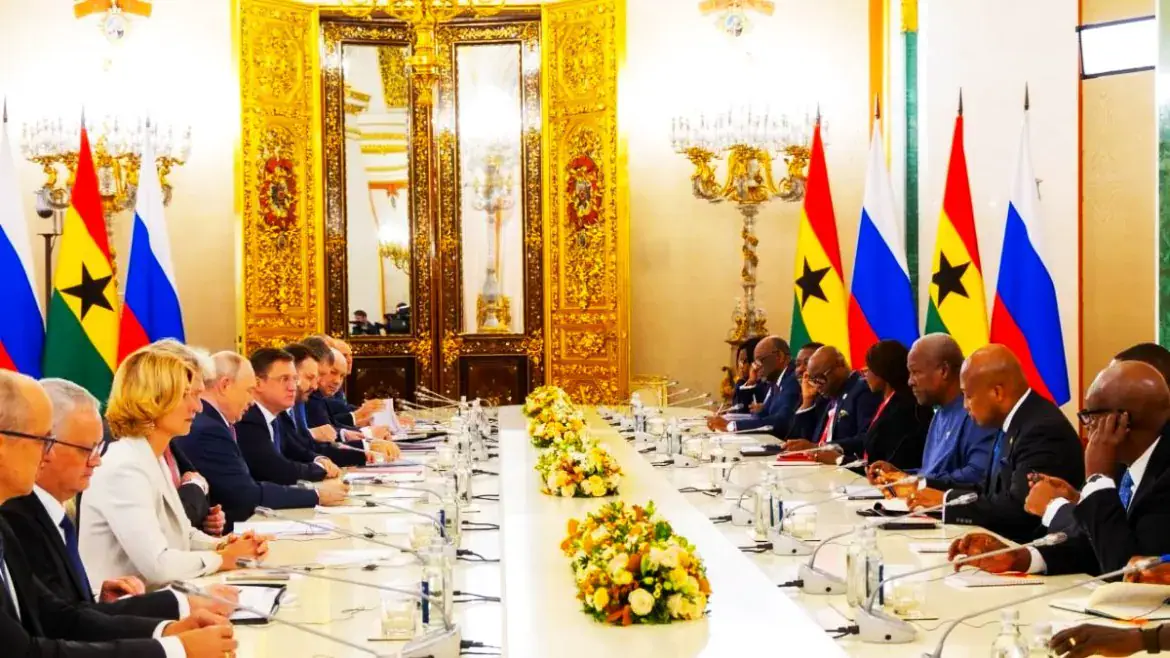
Russian Foreign Minister Sergey Lavrov has expressed support for Ghana's application to join BRICS as a partner country. The announcement was made during a breakfast meeting with African Foreign Ministers at the Russia-Africa Summit. Lavrov pledged to rally all founding BRICS members to ensure consensus support for Ghana's bid. This development comes as Ghana's Foreign Minister, Samuel Okudzeto Ablakwa, conveyed his country's appreciation to Lavrov, describing him as a great friend.
Ghanaian President John Dramani Mahama recently attended the Russia-Africa Summit, where he secured several concrete commitments with Russian President Vladimir Putin. The agreements include the establishment of a 2,000 megawatts nuclear power plant to guarantee energy security and anchor industrialization. This project is a revival of Osagyefo Kwame Nkrumah's vision, which was truncated by the coup of February 28, 1966. The two countries also agreed to enhance their dual agricultural cooperation aimed at boosting grain production and provision of fertilizers.
The Russia-Africa Summit also saw the signing of a new defence pact between Ghana and Russia. The pact will enable Ghana to acquire strategic military assets for its globally respected armed forces. Additionally, Russia will increase scholarships for Ghanaian students, with Ghana currently ranking second as the African nation with the highest number of students in Russia. President Putin also declared that Ghanaians are no longer allowed to participate in the war with Ukraine, a concern raised by President Mahama.
Ghana's Ministry of Foreign Affairs, in collaboration with the United Nations Office in Accra, recently commemorated the 81st Anniversary of the United Nations (UN) Day with a Flag-Raising Ceremony. The event was held under the theme, "UN at 81: Restoring Trust, Managing Transformation – A United Nations That Delivers for All". Deputy Minister for Foreign Affairs, James Gyakye Quayson, delivered the keynote address, reaffirming Ghana's enduring commitment to multilateralism and the principles enshrined in the Charter of the UN.
Ghana's engagement with the UN is shaped by the vision of its founding President, Osagyefo Dr. Kwame Nkrumah, who recognised that the country's progress was inextricably linked to the freedom, development and well-being of other nations. If accepted, Ghana will become the fourth African state to join BRICS, an international organization currently comprising ten countries. BRICS conceptual origins were articulated by Russian foreign minister Yevgeny Primakov in 1998.
The Mahama Administration said it will continue to uphold Ghana's longstanding foreign policy of non-alignment and friends of all, enemies to none, as Ghana pursues diversified development options in its national interest. Ghana and Russia will also revive the country's Permanent Joint Commission for Cooperation (PJCC), with Moscow ready to host in the next few weeks. This move is expected to strengthen bilateral relations between the two countries.
With Russia's support, Ghana's bid to join BRICS has gained significant momentum. The country's potential membership in BRICS is expected to provide new opportunities for economic growth and cooperation with other member countries. Key aspects of the agreements between Ghana and Russia include the nuclear power plant, defence pact, agricultural cooperation, and increased scholarships for Ghanaian students.
Key points
- Ghana's application to join BRICS has gained Russia's support.
- Ghana and Russia have signed several agreements, including a defence pact and agricultural cooperation.
- Ghana's potential membership in BRICS would make it the fourth African state to join the organization.