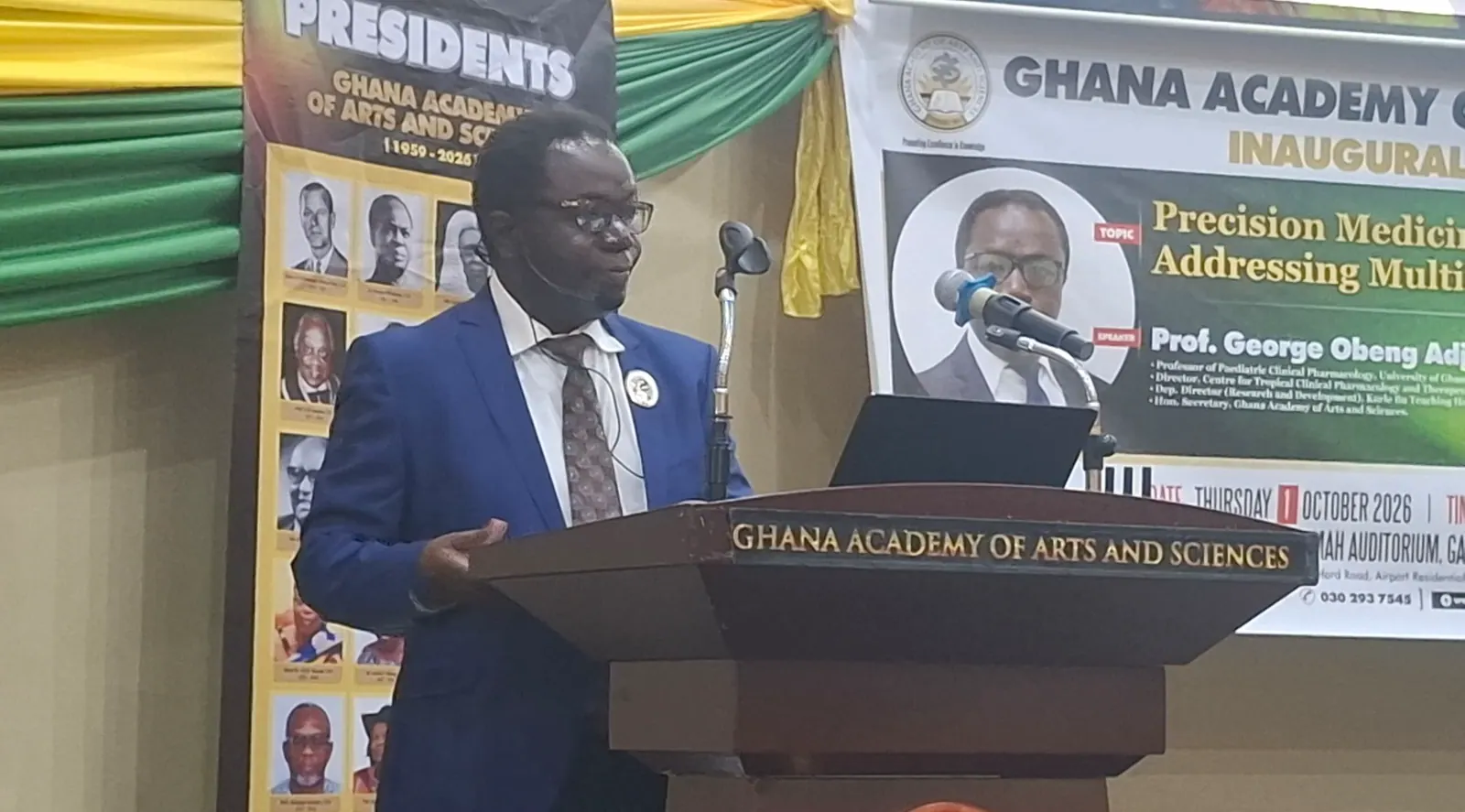
Professor George Obeng Adjei, an Associate Professor of Clinical Pharmacology at the University of Ghana, has urged the establishment of a national precision medicine network to improve healthcare in Ghana. This network would connect existing health, research, and data systems, enabling clinicians and researchers to utilize patient information for safer and more effective treatment. Precision medicine considers an individual's genetic makeup, health history, lifestyle, and environment to determine the most suitable prevention, diagnosis, or treatment.
Prof. Adjei made the call during his 2026 Inaugural Lecture at the Ghana Academy of Arts and Sciences, themed "Precision Medicine or Evidence-Based Medicine: Addressing Multimorbidity in Ghana." He emphasized the need to move beyond a healthcare system that relies heavily on evidence generated from studies of groups of patients with individual diseases, particularly as multimorbidity becomes increasingly common. Multimorbidity, the presence of two or more chronic conditions in the same person, is associated with poorer health outcomes and increased healthcare utilization.
According to Prof. Adjei, multimorbidity is a significant concern in Ghana, with the WHO Study on Global Ageing and Adult Health reporting that 22% of Ghanaian adults aged 50 years and above had two or more chronic conditions between 2007 and 2010. Additionally, the Research on Obesity and Diabetes among African Migrants study found multimorbidity among 31% of rural Ghanaian men and 49% of rural women, compared to 51% of urban men and over 60% of urban women. These statistics highlight the need for a more effective approach to healthcare.
Prof. Adjei noted that Ghana has important building blocks for precision medicine, including clinical research institutions, electronic health systems, disease registries, genomic research, and pharmacogenetic studies. However, he identified gaps in early-stage discovery research, translational research, and locally funded clinical development that need attention. To establish a precision medicine network, Ghana needs to establish secure and interoperable systems linking patients, hospitals, academic research centers, electronic health records, and disease registries.
The professor emphasized the need for strong governance, ethical safeguards, and data protection, stating that "the regulatory and security systems have to precede the network." He also called for sustained financing and the development of a multidisciplinary workforce with expertise in genetics, pharmacogenomics, data science, and computational research. This workforce will be essential in harnessing Ghana's population's genetic diversity to understand disease susceptibility and responses to medicines.
Prof. Adjei highlighted the opportunities offered by Ghana's genetic diversity, particularly since Africans remain underrepresented in global genomic datasets. He proposed a "Ghana programme," described as the "Junior Big Push Agenda," to bring together existing resources and data systems and advance precision medicine in the country. This program aims to leverage Ghana's existing resources to drive progress in precision medicine.
In conclusion, Prof. Adjei's call for a national precision medicine network underscores the need for a more effective approach to healthcare in Ghana. By establishing a network that connects existing health, research, and data systems, Ghana can improve healthcare delivery and outcomes, particularly for individuals with multimorbidity. The proposed "Ghana programme" offers a promising approach to advancing precision medicine in the country.
Key points
- Professor George Obeng Adjei calls for a national precision medicine network to improve healthcare in Ghana
- Multimorbidity is a significant concern in Ghana, affecting 22% of adults aged 50 years and above
- Ghana has existing building blocks for precision medicine, but gaps in research and funding need to be addressed