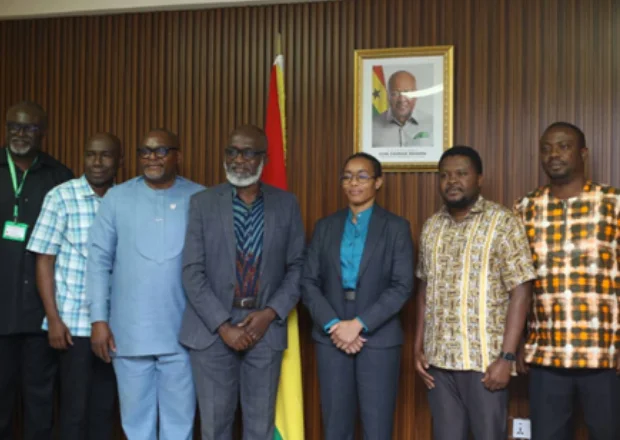
The Government of Ghana has made significant progress in discussions on the establishment of a Space Agency. This move aims to strengthen coordination and utilization of space science and technology for national development. According to Dr. Zanetor Agyemang-Rawlings, Minister for Environment, Science and Technology, the agency will play a crucial role in coordinating the country's space activities and developing national space programs.
Dr. Agyemang-Rawlings made these remarks during her first 100 days public engagement with the media and stakeholders in Accra. The engagement included officials from the Ghana Space Science and Technology Institute (GSSTI) and the Ghana Atomic Energy Commission (GAEC). The Minister emphasized that the agency will enable Ghana to participate more in the growing global space economy. The government plans to transform the GSSTI into a fully-fledged Ghana Space Agency with a suitable legal, institutional, technical, and operational framework.
The need for a dedicated space agency is driven by the increasing importance of space technology to development and the current fragmented nature of space-related activities across government institutions. Dr. Agyemang-Rawlings noted that space technology is no longer the exclusive preserve of a few technologically advanced nations, but an essential infrastructure for development. The Minister highlighted various applications of satellite and geospatial technologies, including telecommunications, weather forecasting, navigation, agriculture, environmental monitoring, disaster management, and scientific research.
The government plans to promote the use of satellite and geospatial data for environmental management, climate resilience, and national development. Dr. Joseph Bremang Tandoh, Director of GSSTI, emphasized that Ghana needs an agency to coordinate space-related activities, which are currently scattered among different institutions. This has resulted in duplication and fragmented use of satellite data. A central agency can coordinate the acquisition and processing of satellite images, making the information available to various government institutions.
Dr. Tandoh mentioned that the global space economy is currently worth about US$630 billion and is projected to reach US$1.5 trillion within the next decade. This presents opportunities for Ghanaian researchers, engineers, entrepreneurs, and young people. An agency can ensure that satellite imagery is acquired under one unit and processed for use by different ministries and agencies. Space technology can support various sectors, including agriculture, disaster management, and environmental monitoring.
The Director of GSSTI highlighted the potential benefits of space technology in predicting agricultural yields, identifying flood-prone areas, and supporting early response to disasters. Satellite technology is already supporting weather forecasting, telecommunications, disaster monitoring, and forest and natural resource management in Ghana. The establishment of a space agency can help harness these benefits and create new opportunities for the country.
The government has already initiated processes towards drafting the necessary Bill, following Cabinet's approval of the initiative. With the establishment of a space agency, Ghana can unlock the potential of space science and technology to drive national development and participate more effectively in the global space economy. The agency will play a crucial role in coordinating the country's space activities and developing national space programs.
Key points
- The Ghanaian government is working towards establishing a Space Agency to coordinate the country's space activities and develop national space programs.
- The agency will enable Ghana to participate more in the growing global space economy, worth about US$630 billion and projected to reach US$1.5 trillion within the next decade.
- Space technology can support various sectors, including agriculture, disaster management, and environmental monitoring, and has the potential to drive national development.