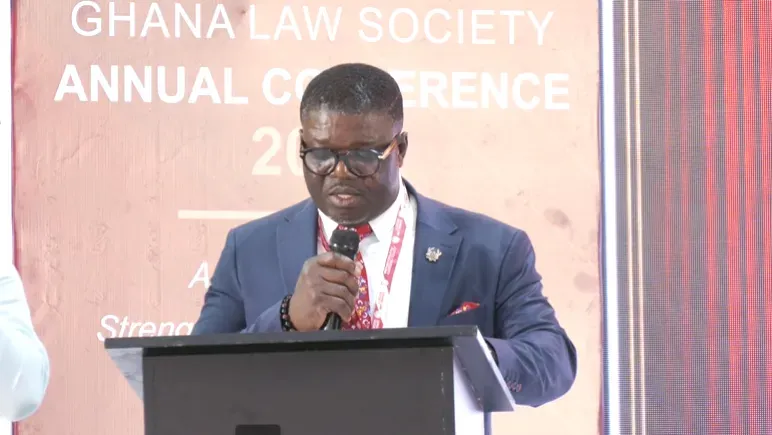
The President of the Ghana Law Society, Rockson-Nelson Etse Kwami Dafeamekpor, has announced a new reform that will turn pupilage into twelve months of structured national service for fresh lawyers. This announcement was made during the Annual Conference of the Ghana Law Society in Accra on 19 September 2026. The scheme is one of seven pillars in the Society's Bar Reform Programme, aimed at addressing the imbalance in the distribution of lawyers across the country.
According to Mr. Dafeamekpor, the current system "overproduces lawyers for Accra and underproduces legal service for Ghana." He noted that over 1,500 students are admitted to the professional law programme each year, and over 1,200 are called to the Bar, only to be left in a saturated and unsupervised market in Accra and Kumasi. This has resulted in fewer than 8,000 lawyers holding active practicing certificates, with over 72% of them practicing in Accra, Kumasi, and Tema.
The current six-month pupilage system has been described as inadequate, with Mr. Dafeamekpor stating that it consists of "six months of carrying files, photocopying processes, loitering in corridors, unpaid, unmentored, unmonitored, and uninspired." He emphasized that this system "teaches hierarchy but not humanity." In contrast, the new scheme will provide a structured national service, where fresh lawyers will be posted to districts for twelve months to work in various capacities.
The Ghana Law Society-National Service Scheme (GLS-NSS) will be run jointly by the GLS and the National Service Secretariat under a Memorandum of Understanding to be executed this year. Fresh lawyers will be posted to districts as Assistant Legal Officers, staff of district offices of the Legal Aid Commission, investigators in district offices of CHRAJ, research assistants to District Magistrates and Circuit Judges, assistants in Regional Lands Commissions, and staff of Regional Offices of the Attorney-General.
To ensure effective supervision and monitoring, each service lawyer will be expected to keep a Pupilage Logbook, submit monthly reports to a Regional Pupil Master appointed by the Society, and complete five mandatory CPD modules. They will also have a Senior Mentor at the Bar and a Field Supervisor at the place of posting. In terms of remuneration, lawyers will receive the standard National Service allowance, topped up by the proposed Ghana Law Society Pupilage Support Fund and support from development partners.
Upon completion of the national service, each lawyer will receive a Certificate of Pupilage and a Certificate of Community Service, both of which will be required to renew the first annual Solicitor's Licence. Mr. Dafeamekpor emphasized that "we must earn the right to private practice by first serving the public." The new scheme aims to produce well-rounded lawyers who are equipped to serve the needs of the country.
The introduction of the GLS-NSS is expected to address the imbalance in the distribution of lawyers across the country, with over 190 districts currently having no law firm. By providing a structured national service, the Ghana Law Society aims to ensure that fresh lawyers are equipped with the necessary skills and experience to practice law effectively, while also contributing to the development of the country's justice system.
Key points
- The Ghana Law Society has introduced a 12-month national service scheme for fresh lawyers, aimed at addressing the imbalance in the distribution of lawyers across the country.
- The scheme will provide a structured national service, where fresh lawyers will be posted to districts to work in various capacities, including as Assistant Legal Officers and staff of district offices of the Legal Aid Commission.
- Upon completion of the national service, each lawyer will receive a Certificate of Pupilage and a Certificate of Community Service, both of which will be required to renew the first annual Solicitor's Licence.