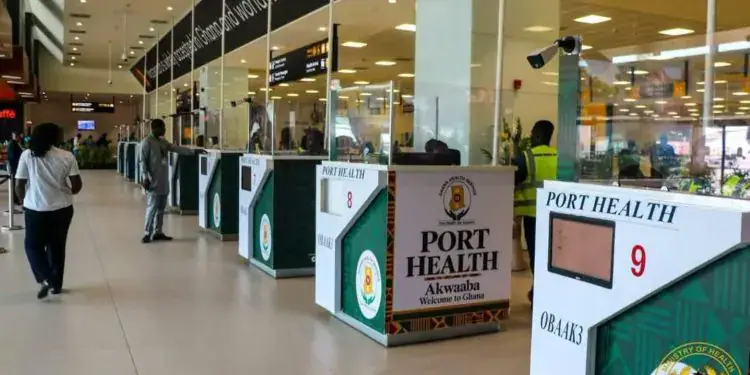
The Ministry of Health in Ghana has intensified border surveillance and health monitoring to prevent the spread of Ebola in the country. As part of the enhanced measures, the Ghana Health Service (GHS) will contact travellers after their arrival at airports to ensure they comply with the required health monitoring protocols. Travellers will be required to report any symptoms associated with the disease to the GHS during the 21-day monitoring period.
The new arrangements are in response to the Ebola outbreak in the Democratic Republic of Congo (DRC), which was officially declared on May 15, 2026, in Ituri province. The World Health Organization (WHO) classified the outbreak as a Public Health Emergency of International Concern (PHEIC) due to rapid spread and cross-border cases in Uganda. Ghana is taking precautionary measures against a potential Ebola outbreak, with the Director-General of the GHS, Dr. Samuel Kaba Akoriyea, indicating that the country is in the face of preparedness.
The GHS has noted that passengers arriving from countries with ongoing transmission will be monitored for up to 21 days. The Ghana Health Service will contact them for follow-up, and they must keep reachable contact details and report any symptoms immediately to the designated contact. The public has been advised to maintain good hygiene practices, including washing hands regularly with soap under running water or using alcohol-based hand sanitizers.
Ghana is also considering the use of artificial intelligence (AI) to predict Ebola and other health threats. According to Dr. Akoriyea, the approach could help authorities respond early rather than wait for an outbreak to become widespread. The Ministry of Health has emphasized that no outbreak has been reported in Ghana, and the public is being advised to report suspected symptoms immediately to the nearest health facility.
In addition to Ebola, the GHS is also taking measures to prevent the spread of Hantavirus, which has been reported on a cruise ship docked in Cape Verde. The cruise ship reportedly carried crew members primarily from the Philippines, with passengers from the United States, Europe, South America, Australia, and parts of Asia. The GHS has noted that eight suspected cases, five confirmed infections, and three deaths have been recorded on the vessel as of May 7.
The GHS has activated its Port Health Division and other public health structures to reduce the risk of importation of Hantavirus. Enhanced surveillance has been deployed at all ports of entry, including airports and seaports. Health facilities nationwide have been directed by the Service to intensify monitoring and reporting of unusual respiratory illnesses. The public has also been advised to maintain proper hygiene, keep their surroundings clean, store food safely, dispose of waste properly, and avoid contact with rodents and their droppings.
Meanwhile, the National Health Insurance Authority (NHIA) has disbursed over GH¢392 million in vetted claims to healthcare providers across Ghana between December 2025 and January 2026. The payments cover services provided under the National Health Insurance Scheme (NHIS). The NHIA has also proposed a 120 per cent increase in service tariffs, pending approval from its Board and the Minister of Health, to ease the financial burden on citizens and ensure equal access to healthcare.
Key points
- Travellers from high-risk countries will be monitored for 21 days
- Ghana is considering the use of AI to predict Ebola and other health threats
- The GHS has activated measures to prevent the spread of Hantavirus