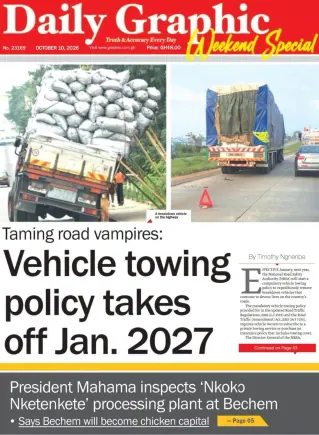
The National Road Safety Authority (NRSA) of Ghana has announced that a compulsory vehicle towing policy will take effect from January 2027. This policy, provided for in the updated Road Traffic Regulations, 2026 (L.I 2519) and the Road Traffic (Amendment) Act, 2025 (Act 1153), requires vehicle owners to subscribe to a private towing service or purchase an insurance policy that includes towing cover. The policy aims to address the issue of abandoned vehicles on highways, which have been a major cause of road accidents and fatalities in the country.
For over two years, Ghanaian highways have witnessed a dangerous pattern of broken down trucks, tankers, and buses parked in the middle of the road or on the shoulder for extended periods. These abandoned vehicles, often without reflectors or warning triangles, have been referred to as "road vampires" due to their potential to cause accidents at night. The Eastern Corridor Road, Accra-Cape Coast road, Accra-Aflao road, Takoradi-Elubo road, Kumasi-Techiman road, and Kumasi-Tamale road are some of the highways where this issue has been prevalent.
According to the Director-General of the NRSA, Abraham Amalita, the implementation of the towing policy is long overdue and can save thousands of lives if done with transparency. He explained that Regulation 214(2) requires drivers to display at least one emergency warning sign when their vehicle is stationary on the roadway or shoulder. However, this regulation has often been disregarded, leading to numerous accidents and fatalities.
Statistics from the Ghana Police Service show that over the past 35 years, from 1991 to 2025, 63,599 persons died from reported road crashes in Ghana. An analysis of a 10-year period from 2012 to 2022 reveals that out of 23,490 people killed, 687 deaths were directly linked to abandoned vehicles on the road. This translates to nearly three percent of all road deaths, or approximately 1,908 lives that could have been saved if disabled vehicles were promptly towed.
The idea of a towing policy is not new in Ghana. In October 2016, the government, through the NRSA, signed an agreement with the Road Safety Management Services Limited for towing services. However, the policy was met with resistance and eventually collapsed due to lack of adequate engagement, transparency in the selection of the contractor, and trust issues. This time, the NRSA must ensure that the policy is implemented with transparency and that vehicle owners are adequately engaged.
Vehicle owners have expressed concerns about the additional cost of subscribing to a towing service or buying insurance that includes towing. The NRSA must ensure that the cost is modest and clearly explained to vehicle owners. Additionally, the towing policy must be accompanied by strict enforcement of Regulation 214(2) on warning triangles and driver education. The Motor Traffic and Transport Department of the Ghana Police Service must be empowered and equipped to remove vehicles that are not towed within a specified timeframe.
With the implementation of the towing policy just three months away, the NRSA has a critical window for intensive public education, publishing the list of approved towing companies, unveiling the app, and explaining the fee structure. The insurance industry must also be brought on board to ensure a smooth implementation of the policy. Ultimately, the success of the towing policy will depend on effective collaboration between stakeholders and a commitment to reducing road accidents and fatalities in Ghana.
Key points
- The policy aims to address the issue of abandoned vehicles on highways, which have caused 687 deaths over a 10-year period.
- The towing policy requires vehicle owners to subscribe to a private towing service or purchase an insurance policy that includes towing cover.
- The implementation of the policy is expected to save thousands of lives if done with transparency and effective enforcement.