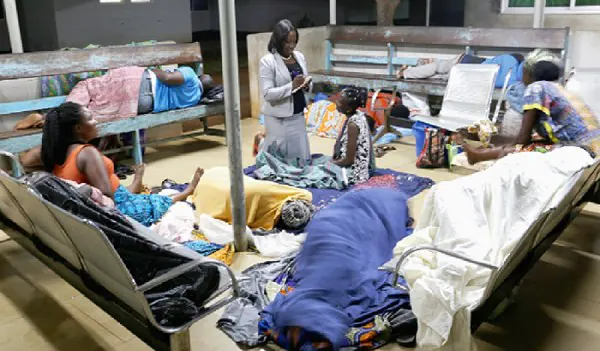
Ghana's Health Minister, Kwabena Mintah Akandoh, has announced the launch of a new command centre at Ridge Hospital that enables him to monitor emergency bed availability in real-time across the country. This development is part of a pilot project aimed at addressing the 'no bed syndrome' crisis, where patients are often turned away or shuttled between hospitals due to a lack of available emergency beds. The system provides live data on bed occupancy at selected regional and teaching hospitals.
The command centre's screen in the Health Minister's office displays the number of empty emergency beds at Korle-Bu Teaching Hospital and other facilities nationwide. Akandoh explained that if a hospital reports no available beds, he can verify the claim directly from his office by checking the actual number of beds and patients in the emergency ward. This is made possible by beds fitted with barcodes and designated 'commanders' at each facility responsible for feeding data into the network.
The pilot project covers selected regional and teaching hospitals, including Korle-Bu Teaching Hospital, Komfo Anokye Teaching Hospital, Tamale Teaching Hospital, and 37 Military Hospital. Akandoh emphasized that the initiative is not meant to create new beds but to help hospitals manage their limited capacity more efficiently. The system will also track how long patients remain in emergency wards, allowing officials to investigate cases where patients stay beyond 24 hours while hospitals claim to have no space.
The project builds on earlier reforms by the Ghana Health Service, which rolled out a real-time bed tracker as part of a broader effort to end 'no bed syndrome'. This phenomenon has been blamed for several preventable deaths and has been a longstanding concern in public discussions about Ghana's health system. Akandoh outlined related expansion efforts, including increasing emergency capacity at major hospitals.
At Korle-Bu Teaching Hospital, the emergency unit currently has around 67 beds out of over 1,000 beds across the entire hospital. A 400-bed facility, described as a 'hospital within a hospital', is under construction, with the contractor already on site. The National Ambulance Service has been integrated into the bed-tracking network to help determine where patients should be sent.
Over 200 ambulances are currently in service after the government insured its entire ambulance fleet in 2025. An additional 100 brand-new ambulances are planned for addition in 2027 to replenish the fleet. The integration of the National Ambulance Service with the bed-tracking system aims to streamline patient transportation and hospital admissions.
The command centre at Ridge Hospital serves as the nerve centre of the rollout, with teaching hospitals and regional hospitals already feeding data into the system. While there is no specified date for expanding the bed management system to cover all regional and district facilities nationwide, officials have expressed their commitment to scaling up the initiative to address the 'no bed syndrome' crisis effectively.
Key points
- The Ghanaian government has launched a pilot project to track hospital bed vacancies in real-time.
- The system aims to address the 'no bed syndrome' crisis by optimizing bed management and streamlining patient transportation.
- The project is part of a broader effort to improve Ghana's health system and reduce preventable deaths.