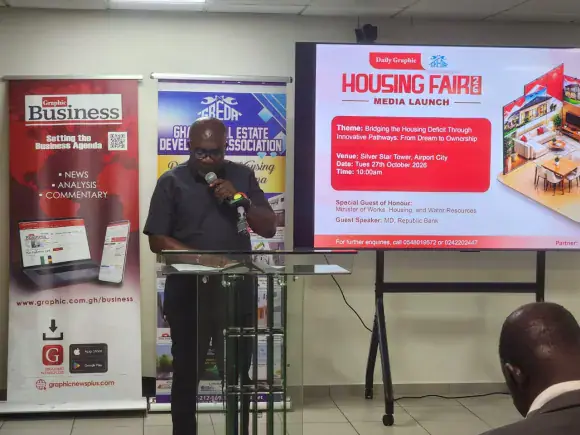
The Deputy Minister of Works, Housing and Water Resources, Gizella Tetteh-Agbotui, has urged real estate developers to invest in other regions of Ghana beyond the south. She made this appeal at the media launch of the Graphic-GREDA Housing Fair 2026 in Accra on October 27, 2026. The concentration of real estate activities in the south has limited the benefits of modern housing developments, while potentially viable markets in other parts of the country remain untapped.
Tetteh-Agbotui stressed that Ghanaians in the Northern, Upper East, Upper West, Savannah, Bono, Ahafo, and other regions equally deserve access to quality housing and modern real estate developments. She encouraged developers to undertake market research in underserved regions to identify potential customers and take advantage of relatively cheaper land. This, she believes, will help address regional disparities, stimulate local economies, and open new markets for developers.
The Graphic-GREDA Housing Fair 2026, scheduled for December 3-5, 2026, will focus on major barriers to homeownership, including high construction costs, limited access to long-term financing, and fraudulent property transactions. Developers, financial institutions, regulators, prospective homeowners, and industry players will meet to explore practical solutions to Ghana's housing challenges. The event is being organized by the Graphic Communications Group Ltd (GCGL) and the Ghana Real Estate Developers Association (GREDA), in partnership with Media General.
The three-day fair will feature an innovation hub showcasing alternative building materials and modern construction technologies, a housing finance hub connecting prospective homeowners and developers to financing opportunities, and a property verification and trust hub to guide land documentation, property verification, and secure transactions. Green housing and smart-home solutions will also feature prominently at the fair.
The Deputy Minister also urged greater adoption of sustainable local building materials to reduce construction costs while assuring developers of the government's commitment to improving housing finance and supporting sustainable housing delivery. The government has introduced a mortgage facility with an attractive interest rate of 8.4 percent per annum through the National Housing Fund, in partnership with the Republic Bank and other commercial banks.
The President of GREDA, Dr. James Ato Orleans-Lindsay, emphasized the need for greater reliance on locally produced building materials and innovative construction technologies to reduce the country's housing deficit. He cited locally manufactured bricks, pozzolana cement, and bamboo as alternatives that could lower construction costs, reduce dependence on imported materials, and create jobs. Dr. Orleans-Lindsay also called for targeted tax incentives for locally manufactured building materials and a review of taxes that increase property acquisition costs.
Representing the Managing Director of the Republic Bank (Ghana) PLC, Dr. Benjamin Dzoboku, Frank Oppong-Yeboah highlighted the paradox of Ghana's housing situation, where large numbers of properties remain unfinished or vacant despite the housing deficit. He attributed this situation partly to property prices being beyond the reach of intended buyers and inadequate knowledge of available financing options. The Republic Bank is prepared to intensify public education on financing options to help developers complete projects efficiently and prospective homeowners access suitable mortgage products.
Key points
- The Ghanaian government has committed about GH¢1 billion to the National Housing Fund for the 2027 fiscal year.
- The Graphic-GREDA Housing Fair 2026 aims to bring together developers, financial institutions, regulators, and prospective homeowners to address Ghana's housing challenges.
- The event will feature an innovation hub, a housing finance hub, and a property verification and trust hub to provide a comprehensive housing solutions marketplace.