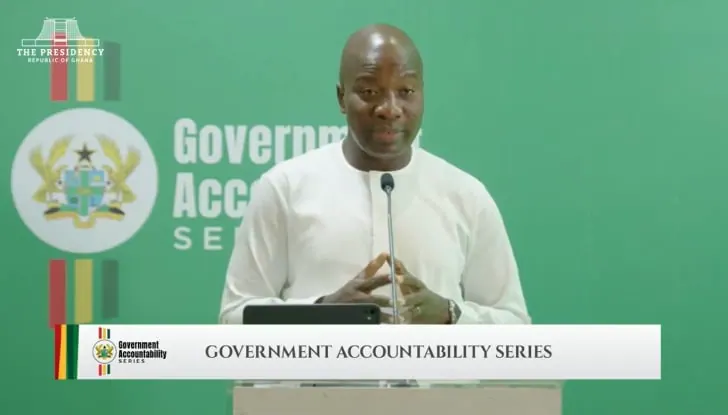
Ghana's Minister of Local Government, Chieftaincy and Religious Affairs, Mahama Ayariga, has expressed confidence that the government will make significant progress in tackling the country's waste management challenges within the next year. Speaking at his maiden appearance on the Government Accountability Series at the Jubilee House in Accra, Mr Ayariga said the government's sanitation interventions would produce visible results within 12 months. He stated that President John Dramani Mahama's administration is committed to addressing the issue.
According to Mr Ayariga, the sanitation difficulties confronting many Metropolitan, Municipal and District Assemblies (MMDAs) are largely the result of structural deficiencies rather than a lack of commitment. He argued that it would be unfair to continue sanctioning assemblies over poor sanitation without first addressing the infrastructure challenges that contribute to the problem. The Minister cited the limited number of waste transfer stations in Accra as a major challenge.
The condition of landfills in the Greater Accra Region is dire, with the region having only one landfill site despite a population of close to seven million. Mr Ayariga noted that the facility "deserves to be immediately decommissioned" but continues to operate because there is no adequate alternative. The only engineered landfill currently available to the region is located in the Eastern Region, highlighting the need for new infrastructure.
To address the infrastructure gap, the government is engaging the Minister of Finance, Dr Cassiel Ato Forson, over plans to construct at least three landfill sites and 36 transfer stations across Greater Accra. The Land Use and Spatial Planning Authority (LUSPA) has completed the necessary zonal demarcations based on population densities and proposed locations for the three landfill sites. This move aims to improve waste management in the region.
President Mahama has directed Mr Ayariga to explore the establishment of incineration facilities that would allow waste to be burnt instead of relying solely on landfills. This approach is intended to prevent the country from facing another shortage of landfill capacity in the coming years. The proposed landfills will be smaller than conventional facilities, incorporating landfill gas-to-energy technology to reduce waste.
Work on a national sanitation strategy is at an advanced stage, with the Finance Minister awaiting the full costing for the construction of engineered landfills in all regional capitals. The strategy includes providing waste collection vehicles, tricycles and household waste bins, with the cost of waste collection to be recovered through household fees collected through an automated payment system.
The government expects the initiative to create at least 20,000 permanent jobs in waste management and the circular economy. The strategy will also require waste to be separated at the household level and maintained through the collection process up to the transfer stations. This move aims to reduce the financial burden on households while making waste collection more convenient.
Key points
- The Ghanaian government is confident in its ability to make significant progress in tackling the country's waste management challenges within the next year.
- The government plans to construct at least three landfill sites and 36 transfer stations across Greater Accra to address the infrastructure gap.
- The initiative is expected to create at least 20,000 permanent jobs in waste management and the circular economy.