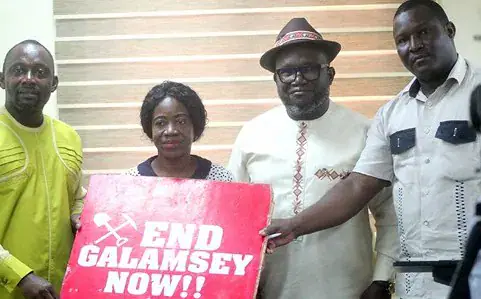
The Media Coalition Against Galamsey, led by Ing. Dr Ken Ashigbey, has expressed concerns that the Ghanaian government has not implemented a request made to President John Dramani Mahama in October 2025. The request was for regular public reporting on water quality, damaged farmlands, and heavy metals in food crops. Dr Ashigbey stated that the coalition's request was made to ensure transparency and accountability in the fight against illegal mining, known locally as galamsey.
Dr Ashigbey appeared on TV3 on November 28, 2026, and revealed that despite the request, the government has not taken any action. He emphasized that the absence of regular monitoring and reporting makes it difficult for the public to assess the effectiveness of the anti-galamsey campaign. The lack of data from Ghana Water Limited, the state utility responsible for supplying and treating drinking water, further exacerbates the issue. Dr Ashigbey noted that even basic data, such as turbidity reports, are now hard to obtain.
According to Dr Ashigbey, activities associated with galamsey appear to have scaled down in some areas by 2024 but are now visible again along major roads and in communities. He cited stretches along the Accra-Kumasi road, including Bonsu, Eninim, and Aseno, as well as the route from Tarkwa through Aseikropon and Ayamfuri towards Obuasi, as areas where illegal mining can be seen. Dr Ashigbey argued that the lack of proper monitoring and enforcement undermines the government's anti-galamsey efforts.
Dr Ashigbey cited the Ghana Gold Board (GoldBod) as an institution making progress against illegal gold trading and smuggling due to its targeted approach. He suggested that the same approach, focusing on financiers and networks rather than small-scale operators, should be applied more broadly in the galamsey fight. This approach, according to Dr Ashigbey, would be more effective in addressing the issue.
The government's anti-galamsey measures have continued, with the Lands Ministry recently launching three Responsible Cooperative Mining Societies in the Akyemansa District of the Eastern Region. This initiative is part of a broader strategy that includes the Blue Water Guards and the National Anti-Illegal Mining Operations Secretariat (NAIMOS). The Media Coalition Against Galamsey's concerns come amid ongoing debates about the effectiveness of the government's anti-galamsey efforts.
The galamsey debate has been ongoing, with various stakeholders expressing concerns about its impact. Kuapa Kokoo's managing director has raised concerns about the effect of galamsey on cocoa supply, while lawyer Kwame Jantuah has called for the adoption of Guinea's tougher crackdown model. Reports have also emerged of armed foreign miners returning to a shut-down site near Konongo.
Dr Ashigbey's remarks come days after Abraham Amaliba, Director-General of the National Rescue and Security Agency (NRSA), described it as a "disgrace" that Ghana's military, which performs well on peacekeeping missions abroad, cannot stop illegal mining at home. The government's inaction on the Media Coalition's request has raised questions about its commitment to addressing the galamsey issue.
Key points
- The Ghanaian government has not acted on a year-old request for regular water-quality and land-damage reporting.
- The lack of monitoring and reporting is making it difficult to assess the effectiveness of the anti-galamsey campaign.
- The Media Coalition Against Galamsey has called for a more effective approach to addressing illegal mining.