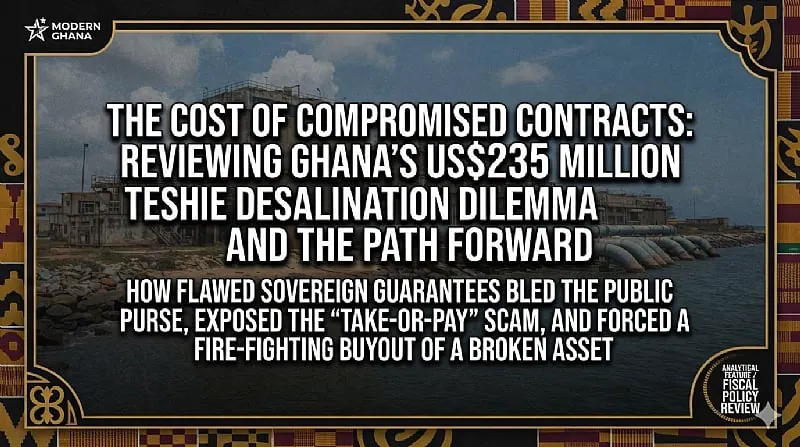
Ghana has been ordered to pay approximately $235 million to Befesa Desalination Developments Ghana Limited, a subsidiary of the Spanish infrastructure group Cox, following an International Chamber of Commerce (ICC) arbitration tribunal ruling on September 17, 2026. The judgment debt stems from the termination of a 25-year "take-or-pay" Water Purchase Agreement signed over a decade ago. The penalty is nearly double the $126 million originally spent to construct the Teshie Desalination Plant, which has sat idle since October 2025.
The Teshie Desalination Plant, West Africa's first desalination plant, suffered from recurrent power supply outages, high production costs, and severe structural vulnerability to adverse weather conditions. The facility's operational inefficiencies, coupled with broader fiscal constraints, led to persistent payment defaults by Ghana Water Limited (GWL), forcing the eventual termination of the contract and triggering parallel international arbitration against both the utility and the state.
The ICC tribunal substantially rejected Ghana's $144.5 million counterclaims, leaving the nation fully exposed to the $235 million debt, with interest backdated and accruing from April 1, 2026. The state guarantee was triggered, leaving the taxpayer to foot the bill for institutional oversights. In a bid to mitigate the financial damage, the government is actively negotiating to purchase the plant entirely at a discounted rate.
The Office of the Attorney-General and Ministry of Justice has indicated that negotiations are advanced to acquire the Teshie Desalination Plant below the arbitral award threshold. A direct buyout represents the most logical exit strategy, as it prevents the immediate enforcement of the full $235 million award and halts the accumulation of high-interest penalties.
Complete state ownership would allow the government to refurbish the plant and restore water flow to an estimated one million citizens in Teshie, Nungua, Spintex, and Sakumono, who have had to rely on expensive water tankers since the shutdown. Additionally, transitioning the plant into a fully state-owned asset would permanently dismantle the restrictive, long-term private equity terms that made water production economically unviable under the previous arrangement.
To turn this crisis into a turning point for national project management, Ghana must adopt aggressive legal and structural changes. The government is considering mandatory parliamentary scrutiny for public-private partnerships (PPPs), particularly those involving long-term "take-or-pay" clauses or sovereign guarantees. An Arbitral Risk Unit may also be established to monitor state-guaranteed projects in real time.
Policy recommendations include integrating dedicated solar or hybrid power systems to make the plant cost-effective upon acquisition, and enforcing strict institutional accountability for state officials and executives who oversee the signing of structurally flawed or unviable public contracts. The Teshie desalination plant crisis serves as a reminder of the financial perils associated with poorly structured public procurement and state guarantees.
Key points
- The ICC arbitration tribunal ordered Ghana to pay $235 million to Befesa Desalination Developments Ghana Limited.
- The Teshie Desalination Plant has sat idle since October 2025 due to operational inefficiencies and fiscal constraints.
- The Ghanaian government is negotiating to purchase the plant at a discounted rate to mitigate financial damage.