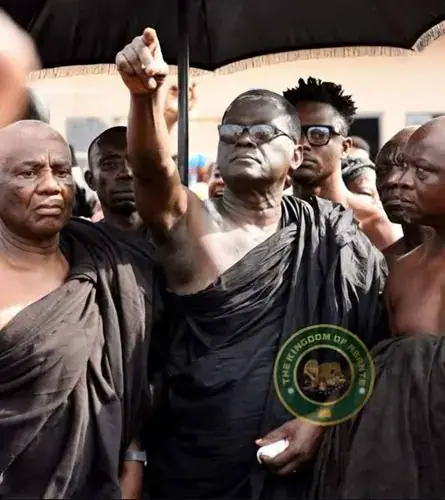
Chiefs in the Asante Akyem enclave of Ghana's Ashanti Region have expressed support for the Minerals Commission's decision to revoke the mining lease of Northern Ashanti Mines. The chiefs, led by the Mennamhene, Nana Tweneboah Kodua Bempah, stated that mining companies must adhere to the law and pay required taxes, mineral right fees, and statutory charges to the state. Failure to meet these obligations justifies the authorities' actions.
The chiefs criticized mining companies that portray themselves as victims after breaching regulations, undermining efforts to promote responsible mining. Nana Tweneboah Kodua Bempah specifically mentioned Northern Ashanti Mines' unpaid mineral right fees and poor record in developing the concession as justification for the revocation. The Konongo chief, Nana Dr Awuah Abedimsa II, also supported the decision, citing the company's failure to demonstrate financial capacity for effective gold mining.
Nana Dr Awuah Abedimsa II urged the Minerals Commission to select a new operator with financial strength, technical expertise, and operational efficiency to develop the concession. The chiefs also called on the incoming operator to comply with Ghana's mining laws and prioritize community development. Nana Tweneboah Kodua Bempah emphasized that the new company must learn from the circumstances that led to the termination of the previous operator's mineral rights.
The Minerals Commission's decision to revoke Northern Ashanti Mines' lease was based on the company's failure to pay outstanding debts and breaches of mining regulations. According to the Commission, the company owed $8.33 million in annual mineral right fees and $49,928 in prospecting licence fees. The Commission served notices on the company in April 2025, but it failed to comply.
The Minerals Commission stated that Northern Ashanti Mines had undertaken no meaningful mining activity on the concession for over two years, breaching Section 69(1) of the Minerals and Mining Act. The Commission notified the Minister of Lands and Natural Resources, who granted approval for the termination. The CEO of the Minerals Commission, Mr Isaac Tandoh, rejected claims of bad faith, stating that the Minister exercised his lawful authority.
Mr Tandoh disputed Northern Ashanti Mines' claim that it had paid $1 million in annual mineral right fees, citing records that showed only $300,000 was paid in two instalments. The Commission's decision was carried out under the Minerals and Mining Act, 2006, and the Minerals and Mining (Licensing) Regulations, 2012.
The revocation of Northern Ashanti Mines' lease has implications for the mining sector in Ghana, highlighting the need for companies to adhere to regulations and prioritize community development. The Minerals Commission's actions demonstrate its commitment to enforcing mining laws and promoting responsible mining practices.
Key points
- The Minerals Commission revoked Northern Ashanti Mines' lease due to unpaid fees and poor performance.
- Chiefs in the Asante Akyem enclave support the decision, citing the need for mining companies to adhere to the law.
- The Commission will select a new operator with financial strength, technical expertise, and operational efficiency.