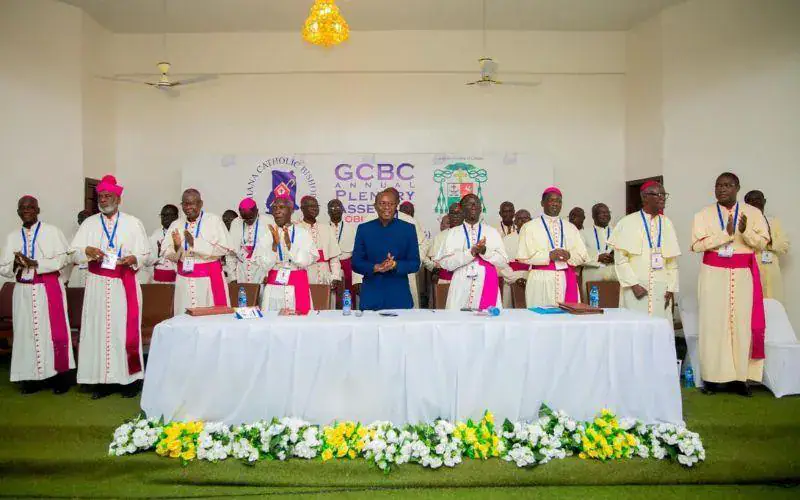
The Ghana Catholic Bishops' Conference has appealed to parties involved in the protracted communal conflicts in Bawku and Kalba-Gbinyiri to abandon violence and pursue dialogue, reconciliation, and peaceful coexistence. The Bishops warned that recurring communal hostilities in parts of the country continued to endanger human lives, disrupt economic activities, weaken social cohesion, and pose threats to national security.
Although acknowledging a recent decline in violent incidents in the affected areas, the religious leaders cautioned that the relative calm must be sustained through deliberate interventions, mutual understanding, and a genuine commitment by all parties to peaceful conflict resolution. The Conference stated that all parties must exercise restraint, renounce violence, and embrace dialogue, reconciliation, and peaceful coexistence.
The Bishops also called for the comprehensive and impartial implementation of recommendations contained in the report addressing the Kalba-Gbinyiri conflict. They cautioned against selective execution of its proposals or unnecessary delays in carrying out the prescribed measures. The communiqué stated that the recommendations must be implemented fully and without undue delay.
The appeal was contained in a communiqué issued at the conclusion of the Conference's annual Plenary Assembly, held from November 3 to 14, 2026, at the Divine Providence Pastoral Centre in Jamasi, within the Konongo-Mampong Diocese of the Ashanti Region. The Conference's intervention highlighted the importance of ensuring that recommendations arising from mediation processes translate into practical measures capable of restoring trust and preventing further confrontations.
The Bishops' demand for the report's recommendations to be implemented fully and without unnecessary delays places renewed emphasis on the government's responsibility to translate the mediation process into concrete action. Their intervention also reinforces the need for sustained cooperation among government institutions, traditional authorities, religious organisations, and community representatives in addressing the underlying causes of the disputes.
In outlining the conditions necessary for a durable settlement, the Bishops emphasised that ending violent confrontations alone would not guarantee lasting peace. They said sustainable reconciliation must be supported by justice, mutual recognition, confidence-building initiatives, and adequate protection for every community affected by the disputes.
The Conference maintained that lasting stability in Bawku and Kalba-Gbinyiri would depend on a collective willingness to reject violence, uphold justice, and build relationships that allow the affected communities to coexist peacefully. The Bishops encouraged traditional authorities, community leaders, and other stakeholders to prioritise constructive engagement, address longstanding grievances, and pursue mutually acceptable solutions to the issues underlying the conflicts.
Key points
- The Ghana Catholic Bishops' Conference has called for an end to violence in Bawku and Kalba-Gbinyiri.
- The Bishops are demanding the full implementation of recommendations to address the Kalba-Gbinyiri conflict.
- Lasting stability in the areas will depend on a collective willingness to reject violence and uphold justice.