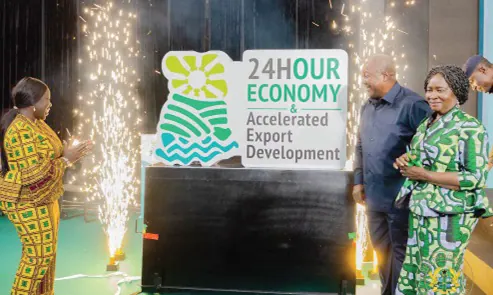
The Secretary-General of the Ghana Federation of Labour, Abraham Koomson, has stated that the government's 24-Hour Economy policy is feasible but will require time and effort to implement. He emphasized that Ghana needs to rebuild and strengthen its manufacturing sector to create the industrial base necessary for a sustainable 24-hour economy.
According to Koomson, Ghana had previously demonstrated its capacity to operate an economy around the clock, citing his experience growing up in Tema during the 1970s. He recalled that factories such as TTL, GTMC, GTP, VALCO, ALU WORKS, NESTLE, LEVER BROTHERS, and STATE FISHING operated three shifts, showing that a 24-hour economy is possible.
Koomson explained that the revival of the policy depends on creating an enabling environment for industries and businesses to operate efficiently and employ workers across multiple shifts. He urged the government to exercise caution in introducing taxes and policies that could undermine industrial growth, citing excessive taxation as a contributor to the decline of Ghana's industrial base.
The Secretary-General criticised the opposition New Patriotic Party (NPP) for its criticism of government policies, particularly the 24-Hour Economy initiative. He urged the party to allow the government to focus on addressing economic challenges inherited from them, questioning the NPP's moral authority to criticise the current administration.
Koomson stressed that rebuilding Ghana's industrial capacity, supporting local manufacturing, and creating the right conditions for businesses and workers are critical to making the 24-Hour Economy policy sustainable. He maintained that although the policy is achievable, its full implementation will take time, possibly over a year or two.
The Ghana Federation of Labour Secretary-General called on the government to prioritise policies that support workers, factories, and the manufacturing sector. He believes that a strong industrial base will provide the foundation for a sustainable 24-hour economy, enabling the country to correct mistakes made under the previous administration.
Koomson's comments come as the government works to implement the 24-Hour Economy policy, which aims to boost economic activity and create jobs. The policy's success will depend on the government's ability to create an enabling environment for industries and businesses to thrive.
Key points
- The 24-Hour Economy policy is achievable but requires rebuilding Ghana's industrial base.
- Excessive taxation contributed to the decline of Ghana's industrial base and the three-shift system.
- The policy's full implementation will take time, possibly over a year or two.