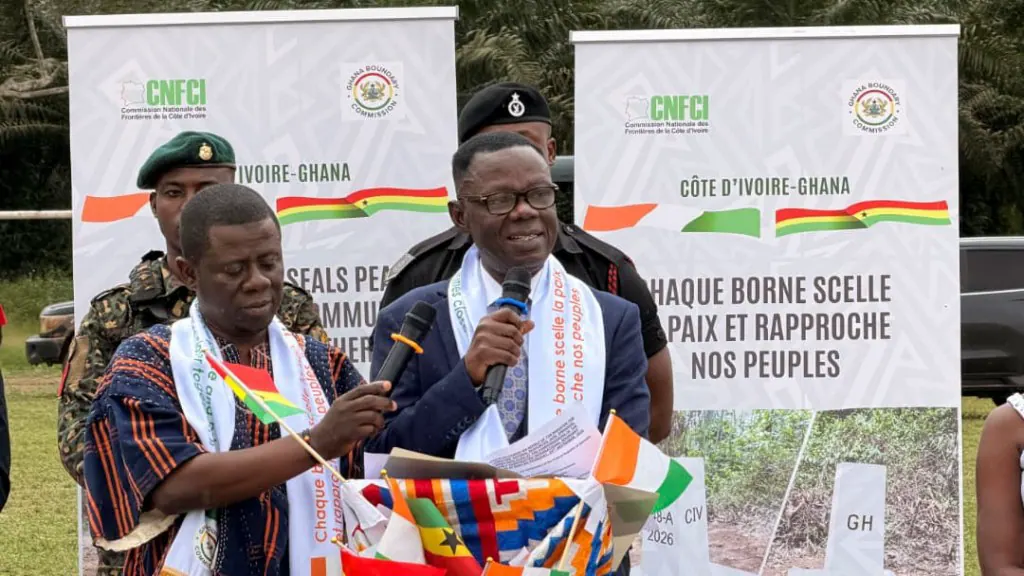
Ghana and Côte d'Ivoire have marked a significant milestone in their bilateral relations with the commissioning of 37 new boundary pillars along a 150km stretch of their shared frontier. The project, which was supervised by the Ghana Boundary Commission, aims to clearly demarcate the border between the two countries, reducing the potential for disputes over land, farmland, or natural resources. The exercise is part of the Joint Ghana-Côte d'Ivoire Land Boundary Reaffirmation Exercise.
The newly commissioned pillars include a special marker at Jomoro, known as the Terminus Pillar, which marks the exact spot where Ghana's land boundary with Côte d'Ivoire gives way to the maritime boundary separating the two countries' waters. This marker is significant for fishing communities and future offshore oil exploration. The Terminus Pillar was unveiled at New Town in the Jomoro Municipality of the Western Region, alongside 12 Main Pillars, 20 Intermediate Pillars, and four Border Crossing Pillars.
The project was fully funded by Germany's development agency, GIZ, together with the African Union Border Programme, and carried out by the 48 Engineer Regiment of the Ghana Armed Forces. Two commissioning ceremonies marked the occasion, with the first taking place at New Town, where the Terminus Pillar was unveiled, and the second at Diby, an Ivorian border community next to Yaakase in the Enchi area.
The boundary pillars are physical markers that fix the precise line separating one country's territory from another's, reducing the scope for disputes between neighbouring communities. For residents living along the Ghana-Côte d'Ivoire frontier, clearly marked pillars mean less ambiguity over which side of the line a farm, a market, or a resource sits on. The pillars are expected to promote peaceful coexistence and cooperation between the two countries.
Ghana Boundary Commission Commissioner General Major General Anthony Ntem emphasized that the newly built pillars support the African Union's vision of a "Borderless Africa". The commissioning of the pillars marks a significant step towards achieving this vision, promoting economic integration, and enhancing regional security.
The Joint Ghana-Côte d'Ivoire Land Boundary Reaffirmation Exercise is a significant undertaking that demonstrates the commitment of both countries to strengthening their bilateral relations and promoting regional stability. The project has been completed in Phase 1, covering 150 kilometres of the shared frontier, with plans for further phases to complete the demarcation of the entire border.
The commissioning of the 37 new boundary pillars marks a major milestone in Ghana-Côte d'Ivoire relations, with significant implications for regional security, economic integration, and the well-being of communities living along the border. The project is expected to have a lasting impact on the region, promoting peaceful coexistence and cooperation between Ghana and Côte d'Ivoire.
Key points
- The project was fully funded by Germany's development agency, GIZ, together with the African Union Border Programme.
- The pillars include a special marker at Jomoro, known as the Terminus Pillar, which marks the exact spot where Ghana's land boundary with Côte d'Ivoire gives way to the maritime boundary.
- The exercise is part of the Joint Ghana-Côte d'Ivoire Land Boundary Reaffirmation Exercise, supervised by the Ghana Boundary Commission.