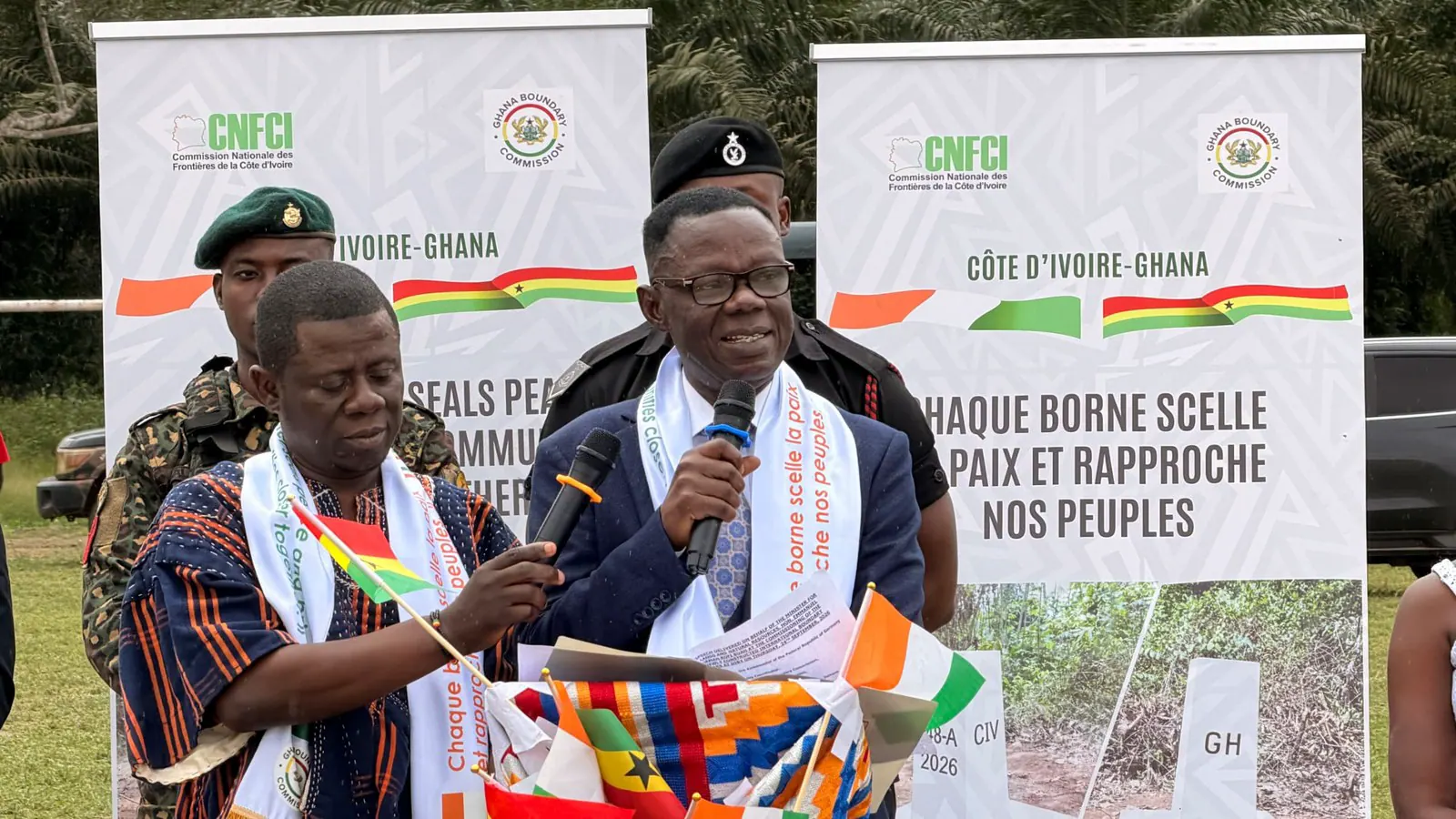
Ghana and Côte d'Ivoire have completed the first phase of a joint reaffirmation exercise with the unveiling of 37 new concrete boundary pillars along their shared 150-kilometre frontier. The pillars were unveiled in two separate ceremonies, one in Ghana's Jomoro Municipality and another in the Ivorian community of Diby. This joint exercise aims to clearly define the border and curb disputes between the two West African neighbours.
The 37 structures comprise one Terminus Pillar, 12 Main Pillars, 20 Intermediate Pillars, and four Border Crossing Pillars. The work was supervised by the Ghana Boundary Commission (GhBC) and executed by the 48 Engineer Regiment of the Ghana Armed Forces. Funding was provided by Germany's development agency GIZ and the African Union Border Programme (AUBP). The pillars mark a significant milestone in the countries' efforts to strengthen their border.
The newly built pillars support the African Union's vision of a "Borderless Africa", which aims to promote free movement of people, goods, and services while encouraging legitimate trade and regional integration. Major General Anthony Ntem, Commissioner General of the Ghana Boundary Commission, emphasized that clearly defined and respected borders are essential for promoting peace and cooperation between nations.
Dr Diakalidia Konaté, Executive Secretary of Côte d'Ivoire's National Boundary Commission, thanked the Joint Land Boundary Technical and Sub-Technical Committees for their work and called on them to sustain their commitment as attention turns to the next phase of the project. The exercise was designed to make the international boundary line more visible on the ground.
German Ambassador to Côte d'Ivoire Matthias Veltin said GIZ's involvement in the project aimed to help prevent conflict along the border. He emphasized that African boundaries should function as points of union rather than separation. The project reflects the two countries' commitment to a 1964 pledge by African states to preserve boundaries inherited from the colonial era.
With Phase 1 complete, attention now shifts to Phase 2 of the Ghana–Côte d'Ivoire Land Boundary Reaffirmation Exercise, which will cover a larger stretch of 400 kilometres. The next phase will be supervised by Côte d'Ivoire's National Boundary Commission. The sources do not specify an exact start date beyond indicating the next phase is expected later this year.
The reaffirmed boundary is expected to offer clearer reference points for settling land claims and easier identification of where one country's jurisdiction ends and the other's begins. For ordinary Ghanaians and Ivorians living along the frontier, particularly farmers and traders in border towns, the new markers are expected to bring clarity and stability to their daily lives.
Key points
- The Ghana-Côte d'Ivoire border reaffirmation exercise aims to promote peace and cooperation between the two nations.
- The project was funded by Germany's development agency GIZ and the African Union Border Programme (AUBP).
- Phase 2 of the exercise is expected to cover a larger stretch of 400 kilometres.