Ghana and Côte d’Ivoire have jointly commissioned 37 newly constructed international boundary pillars, marking the successful completion of Phase 1 of the Joint Ghana-Côte d’Ivoire Land Boundary Reaffirmation Exercise. The exercise, supervised by the Ghana Boundary Commission, covered a total distance of 150 kilometres. The project was fully funded by the German Agency for International Cooperation (GIZ) and the African Union Border Programme.
The 37 pillars comprise one Terminus Pillar, 12 Main Pillars, 20 Intermediate Pillars and four Border Crossing Pillars. Two ceremonies were held to mark the milestone. The first took place at New Town in the Jomoro Municipality of the Western Region, where the Terminus Pillar was commissioned. The pillar marks the end of the Ghana-Côte d’Ivoire international land boundary and the beginning of the international maritime boundary between the two countries.
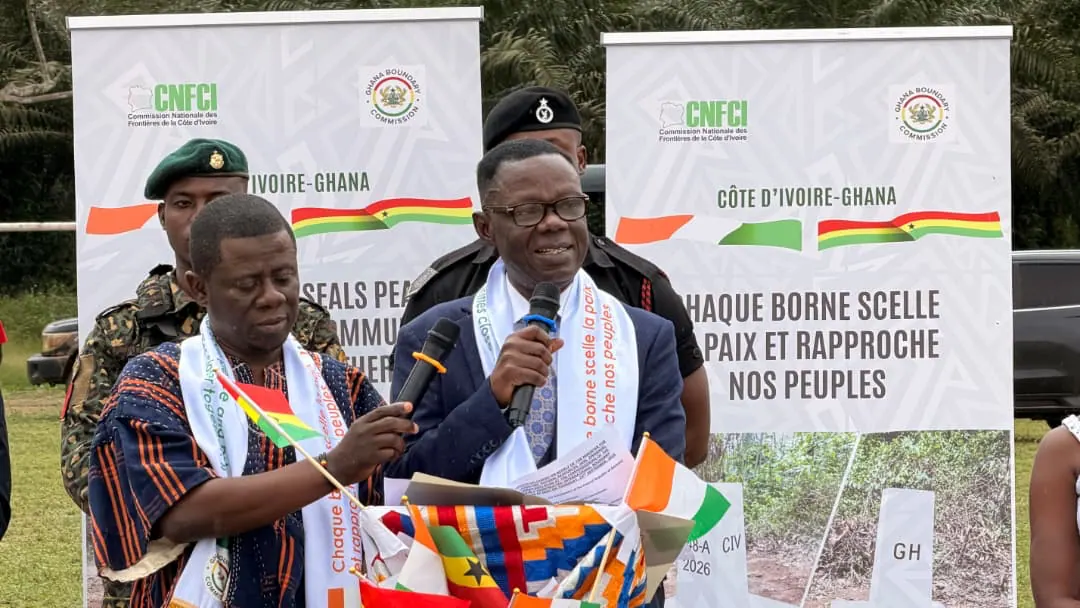
The second ceremony was held at Diby, an Ivorian border community adjacent to Yaakase in the Enchi area, where IBP48 was commissioned. The pillar serves as both a Main Pillar and a Border Crossing Pillar. Commissioner General of the Ghana Boundary Commission, Major General Anthony Ntem, attended the events and noted that the newly constructed pillars reinforce the African Union’s vision of a Borderless Africa.
Major General Ntem stressed that clearly defined and mutually respected boundaries are essential to cooperation, regional integration and peaceful coexistence. He urged stakeholders to regard the new pillars as markers of certainty, cooperation and peaceful coexistence. The Commissioner General added that certainty, trust and cooperation among sovereign states are critical to Africa’s integration.
Executive Secretary of Côte d’Ivoire’s National Boundary Commission, Dr Diakalidia Konate, expressed appreciation to members of the Joint Land Boundary Technical and Sub-Technical Committees for their work during Phase 1. He urged them to maintain the same commitment as Phase 2 approaches. Phase 2 of the reaffirmation exercise is expected to begin later this year and will cover an additional 400 kilometres under the supervision of Côte d’Ivoire’s National Boundary Commission.
German Ambassador to Côte d’Ivoire, Matthias Veltin, reaffirmed Germany’s support for initiatives promoting African integration and cooperation. He said Germany had partnered with the African Union Border Programme through GIZ to support African countries in demarcating, reaffirming and managing their common boundaries. Mr Veltin stressed that African boundaries should serve as points of connection and collaboration rather than separation.
Speaking on behalf of the Minister for Lands and Natural Resources, Emmanuel Armah Kofi-Buah, the Western North Regional Minister, Wilbert Petty Brentum, said the new pillars symbolised the joint efforts of Ghana and Côte d’Ivoire to fulfil commitments made in 1964 by African states to maintain inherited boundaries. He urged stakeholders, particularly leaders and residents in border communities, to protect the pillars and promote peace, cooperation and good neighbourliness between the two countries.
Key points
- The completion of Phase 1 paves the way for Phase 2 of the reaffirmation exercise.
- The project was fully funded by the German Agency for International Cooperation (GIZ) and the African Union Border Programme.
- The 37 pillars comprise one Terminus Pillar, 12 Main Pillars, 20 Intermediate Pillars and four Border Crossing Pillars.