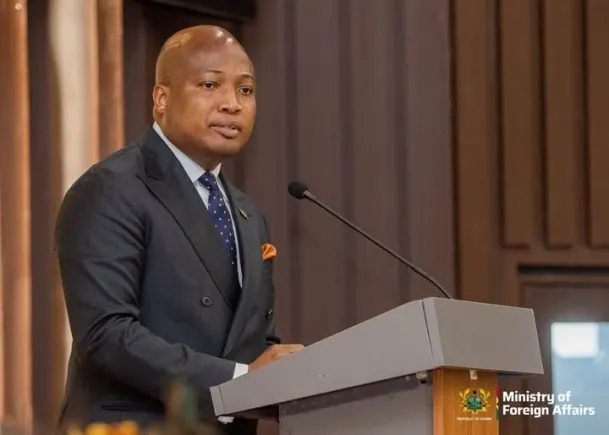
Ghana's Minister for Foreign Affairs, Samuel Okudzeto Ablakwa, has clarified the country's position on BRICS membership. In an interview on TV3's Key Points, Ablakwa stated that Ghana is not seeking full membership of BRICS but intends to apply as a Partner Country. This decision is driven by the desire to prioritize Ghana's national interest, as enshrined in Article 40 of the 1992 Constitution of Ghana.
According to Ablakwa, Ghana already enjoys excellent relations with BRICS member countries, including Brazil, China, Egypt, Ethiopia, India, Indonesia, Iran, Russia, Saudi Arabia, South Africa, and the United Arab Emirates. By joining BRICS as a Partner Country, Ghana aims to leverage this platform for consultation and cooperation on contemporary global and regional issues. BRICS represents a significant trading bloc, and Ghana sees this as an opportunity to strengthen its economic ties.
The Minister dispelled fears that Ghana's decision to apply for BRICS partnership would affect its relations with traditional partner countries. He emphasized that this move affirms Ghana's policy of non-alignment, which has historically allowed the country to maintain strong relationships with multiple international partners. Ablakwa cited President Kwame Nkrumah's ability to secure support from both the United States and the Soviet Union during the Cold War as an example of Ghana's diplomatic flexibility.
Ablakwa revealed that Ghana had prior engagements with European Union member states, during which the country communicated its rationale for seeking BRICS partnership. He stressed that this decision is within Ghana's right to diversify its strategic options for development. The Minister's clarification comes amid interest in Ghana's bid to join BRICS, with some voices arguing that the move could bring economic benefits.
BRICS was formalized in 2006, and its inaugural summit was convened in 2009. The bloc expanded to include South Africa in 2010 and later added Egypt, Ethiopia, Iran, Saudi Arabia, and the UAE as full members in 2024, with Indonesia joining in 2025. Belarus, Bolivia, Kazakhstan, Cuba, Malaysia, Nigeria, Thailand, Uganda, Uzbekistan, and Vietnam also joined as Partner Countries in 2025.
If Ghana's bid succeeds, it will join the ranks of countries like Belarus and Nigeria, which have obtained Partner Country status. Ablakwa's announcement has sparked discussions on the potential implications of this move for Ghana's economy and international relationships. Some experts have called for a clear strategy to manage risks associated with this new partnership.
The development has elicited mixed reactions, with some Ghanaians expressing support for the move, while others have raised concerns. As Ghana moves forward with its application, it will be crucial to monitor the implications of this decision on the country's economic and diplomatic landscape. The government will need to navigate these relationships carefully to maximize benefits and minimize potential risks.
Key points
- Ghana is applying for BRICS partnership, not full membership, to prioritize its national interest and diversify strategic options for development.
- The decision is driven by Ghana's desire to leverage BRICS as a platform for consultation and cooperation on global and regional issues.
- Ghana's move to join BRICS as a Partner Country has sparked discussions on potential economic benefits and implications for its international relationships.