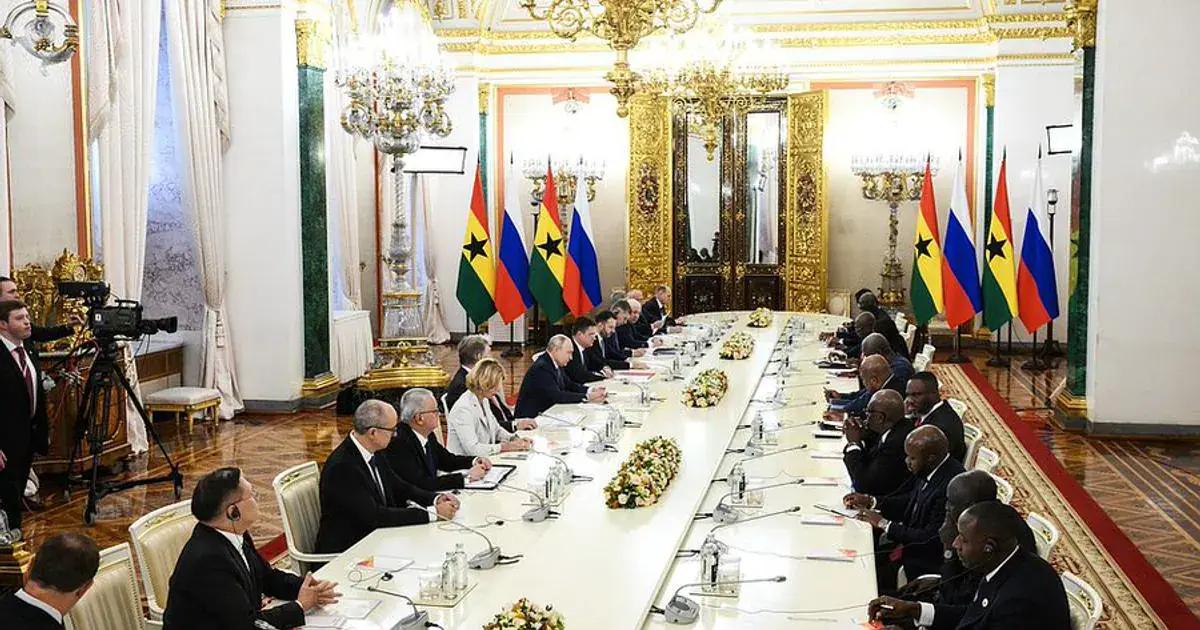
On October 30, 2026, Ghanaian President John Dramani Mahama and Russian President Vladimir Putin held bilateral talks at the Russia-Africa Summit in Moscow. The discussions resulted in six key commitments aimed at strengthening cooperation between the two nations. According to Foreign Affairs Minister Samuel Okudzeto Ablakwa, the summit was a successful engagement that yielded concrete outcomes. The commitments cover various areas, including energy, defense, agriculture, education, and security. President Mahama's visit marked a significant milestone in Ghana-Russia relations, which have been cordial and mutually beneficial since 1958.
One of the major outcomes is Russia's agreement to work with Ghana towards establishing a 2,000-megawatt nuclear power plant. The proposed facility is expected to strengthen Ghana's electricity supply and provide the energy needed to support industries and economic activities. A nuclear power plant uses energy released from nuclear reactions to produce heat, which is then used to generate electricity. This project represents a renewed effort to realise Ghana's nuclear energy ambition, which was first envisioned by the country's first President, Dr. Kwame Nkrumah.
The second commitment involves a new defense agreement under which Russia will support Ghana in acquiring strategic military equipment for the Ghana Armed Forces. The aim is to strengthen the country's military capabilities and improve its ability to protect its territorial integrity. This announcement follows earlier engagements between Ghana's military authorities and a Russian delegation. The new defense pact is expected to enhance Ghana's defense capabilities and promote regional security.
The third commitment focuses on agriculture, particularly grain production and the supply of fertilizers. According to Minister Ablakwa, the two countries will strengthen their agricultural relationship to help Ghana produce more grains and improve access to fertilizers. This could support Ghana's efforts to improve food production, reduce dependence on imported food, and strengthen food security. Ghana and Russia will enhance their agricultural cooperation to boost grain production and provide fertilizers.
Russia has also agreed to increase scholarship opportunities for Ghanaian students seeking higher education in the country. According to Minister Ablakwa, Ghana currently ranks second among African countries in terms of the number of students studying in Russia. In August 2026, Russia increased its annual allocation for Ghanaian students from 120 to 240. The proposed increase could provide more opportunities for Ghanaian students to pursue higher education and acquire specialized skills.
Another major outcome concerns the involvement of Ghanaians in the ongoing war between Russia and Ukraine. According to Minister Ablakwa, President Mahama raised concerns about Ghanaians being recruited to participate in the conflict during his discussions with Putin. The Russian President has declared that Ghanaians would no longer be allowed to participate in the war, whether through irregular recruitment arrangements or voluntary interest. This commitment is expected to address a major concern for the Ghanaian government.
The final commitment is the revival of the Permanent Joint Commission for Cooperation (PJCC), a platform for the two countries to discuss and coordinate areas of bilateral cooperation. According to Minister Ablakwa, Russia is prepared to host the next meeting of the commission in the coming weeks. The revival is expected to provide an opportunity for officials from both countries to follow up on the implementation of the commitments made during the summit.
Key points
- Russia has agreed to work with Ghana to establish a 2,000-megawatt nuclear power plant to guarantee energy security and anchor industrialization.
- A new defense pact will provide strategic military assets for the Ghana Armed Forces to strengthen the country's military capabilities.
- Russia will increase scholarships for Ghanaian students, with an annual allocation that has been doubled to 240.