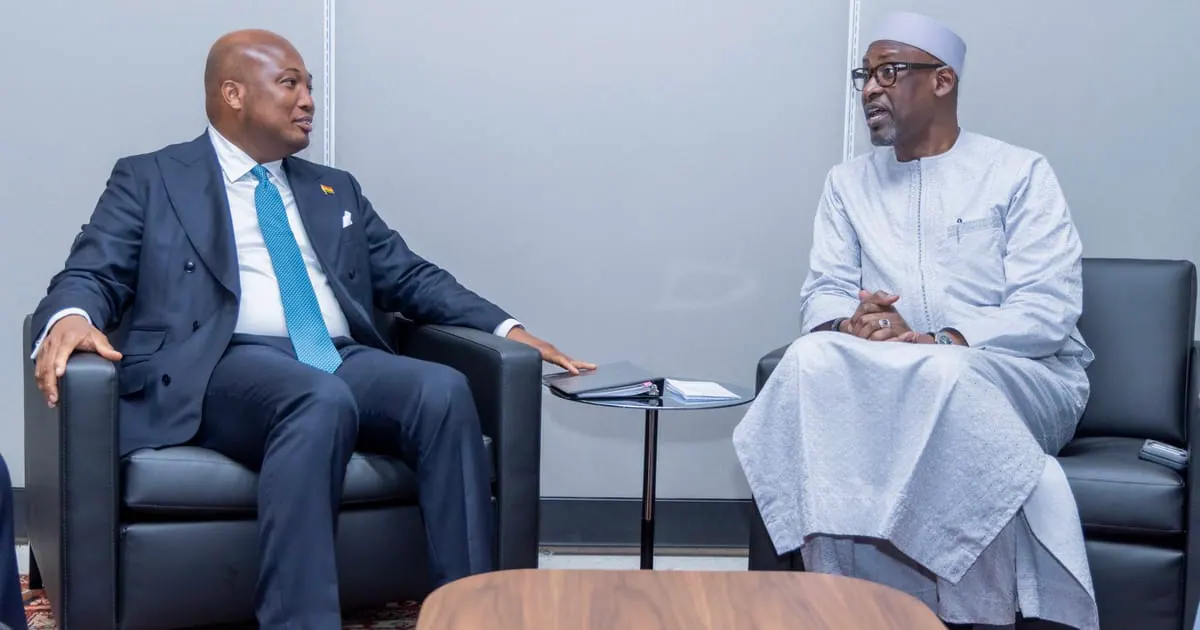
Ghana and Mali have agreed to strengthen their collaboration in combating violent extremism, instability, and climate change. The agreement was reached during a meeting between Ghana's Minister of Foreign Affairs, Samuel Okudzeto Ablakwa, and his Malian counterpart, Abdoulaye Diop, on the sidelines of the 81st UN General Assembly. The two countries aim to pursue homegrown solutions to unlock the full development potential of their region.
The meeting between the two foreign ministers was an opportunity for Ghana to reiterate its commitment to its partnership with the Alliance of Sahel States (AES), which is anchored on trust and solidarity. According to Minister Ablakwa, Ghana cherishes its rich history and inseparable bond with Mali, particularly since the days of African Integration with the Ghana-Mali-Guinea union.
President John Dramani Mahama also addressed the security challenges confronting the Sahel region, tracing the escalation of instability to the aftermath of the Libya conflict and the proliferation of arms. He stressed that subsequent military coups should be understood within this broader security context. The President made these remarks while speaking at the Council on Foreign Relations in New York.
During his address at the Council on Foreign Relations, President Mahama outlined the thinking behind the Accra Reset and Ghana's broader vision for a more self-reliant and integrated Africa. The Accra Reset was prompted by the withdrawal of $174 million in programmed development support, including a $74 million annual gap in the health sector. This exposed vulnerabilities in critical areas such as medical research, HIV testing, and PEPFAR-supported programmes.
President Mahama emphasized the need for African health sovereignty, with the continent building its own capacity to produce medicines and vaccines rather than remaining dependent on external supply chains. He also called for continued dialogue and the rebuilding of bridges between ECOWAS and the Alliance of Sahel States (AES), noting that the fight against terrorism requires regional and international cooperation.
As part of efforts to protect Ghana's borders, the country is strengthening surveillance and intelligence-sharing with neighbouring countries. Looking ahead to Ghana's 2027 AU Chairmanship, President Mahama said Ghana intends to make the chairmanship impactful, with priorities including advancing regional integration, facilitating the movement of goods across Africa, and supporting continental efforts to promote peace and security.
Ghana's strategic pursuit of Afro-Pragmatism is yielding the desired results, according to Minister Ablakwa. The country is committed to working with its partners to address the complex challenges facing the region, including violent extremism, instability, and climate change. By working together, Ghana and Mali aim to unlock the full development potential of their region and promote a more self-reliant and integrated Africa.
Key points
- Ghana and Mali agree to collaborate on violent extremism, instability, and climate change.
- President Mahama emphasizes the need for African health sovereignty.
- Ghana to prioritize regional integration, goods movement, and peace promotion during its 2027 AU Chairmanship.