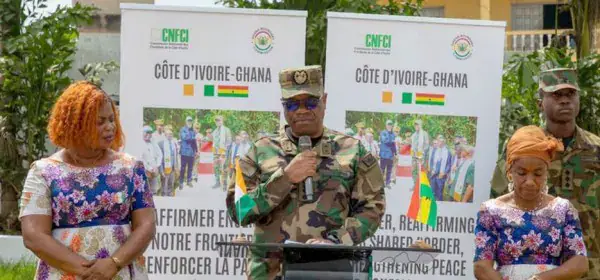
The governments of Ghana and Côte d'Ivoire have initiated the second phase of their joint exercise to reaffirm their common land border, focusing on enhancing security, preventing territorial disputes, and promoting peaceful coexistence. This phase covers a 392-kilometer stretch from Aowin municipality in Ghana's Western North Region to Banda district in Côte d'Ivoire's Bono region.
A total of 57 new international border markers will be installed along this section under Côte d'Ivoire's supervision. The project, which started in November 2026, is expected to be completed by the end of the year. The Ghana Boundary Commission (GhBC) views this development as a significant milestone in efforts by both countries to improve border management and foster peaceful relations between border communities.
The Ghanaian and Ivoirian boundary commissions marked the completion of the first phase, covering approximately 150 kilometers of their land border, on September 22, 2026, in Newtown, Ghana. This second phase aims to clearly define the territorial limits of both countries, facilitating development planning and enhancing security.
Major General Anthony Ntem, Commissioner of the Ghana Boundary Commission, emphasized that precise demarcation is crucial for preventing territorial conflicts, deepening bilateral relations, and enabling central governments to provide basic services. He assured border communities that their legitimate cross-border movements and economic activities would not be disrupted.
Dr. Diakalidia Konate, Executive Secretary of Côte d'Ivoire's National Boundary Commission, highlighted that border disputes are a major source of conflict in Africa. He stressed that clear and visible demarcation of international borders will help prevent such disputes. Konate also warned against the spread of misinformation on social media and called for support from traditional authorities and community members for the technical teams.
The joint project demonstrates the renewed commitment of Ghana and Côte d'Ivoire to avoiding border-related conflicts while strengthening bilateral relations, peace, security, and socio-economic development along their shared border. The initiative was launched in Niablé, Côte d'Ivoire, a locality on the border with Sefwi Oseikojokrom in Ghana's Western North Region.
The successful completion of the border demarcation project is expected to contribute significantly to regional stability and cooperation between Ghana and Côte d'Ivoire. Both countries are working closely together to ensure the project's success, with technical teams from both nations collaborating on the installation of border markers and other aspects of the project.
Key points
- The second phase of the Ghana-Côte d'Ivoire border demarcation project covers 392 kilometers and involves the installation of 57 new border markers.