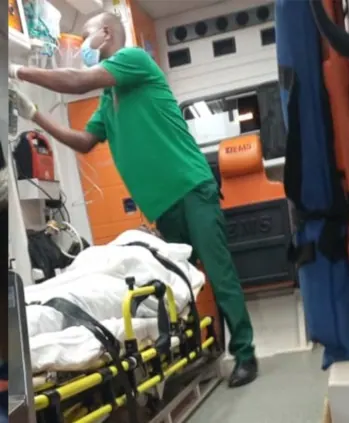
A disturbing incident involving a patient's death due to equipment failure has brought Ghana's ambulance service under scrutiny. Dr. Abigail Afful recounted the events of that fateful night, where a patient with refractory hypoxia was being transported to an ICU facility. Despite efforts to save her life, the patient succumbed to her condition due to a series of equipment failures.
According to Dr. Afful, the ambulance crew was hesitant to transport the patient due to her critical status, requesting a clinician escort from the ER to facilitate the transfer. Dr. Afful agreed to accompany the patient, but not before preparing for the worst by packing essential medical supplies, including an ampule of adrenaline, syringes, and gloves. Her preparedness would soon prove crucial in the patient's treatment.
During the transfer, the oxygen tubing, which was the patient's lifeline, tore, causing life-saving gas to escape into the air. The crew attempted to repair the tube with tape, but it snapped again, rendering the equipment useless. The ambulance was forced to divert to a nearby facility in search of mobile oxygen, a basic requirement of emergency care that was not readily available.
While searching for oxygen, Dr. Afful was manually bagging the patient, watching her deteriorate as the equipment failed. Upon checking the patient's pulse, Dr. Afful unfortunately found none. The crew began CPR, but their efforts were hindered by a lack of essential medical supplies, including adrenaline and syringes. Dr. Afful had to provide these from her own pocket.
The incident highlights the systemic failures within Ghana's healthcare system, particularly in the ambulance service. Dr. Afful identified several key failures, including oxygen tubing that had not been inspected before deployment, faulty and fatal equipment, and no backup oxygen source on the ambulance. These failures ultimately contributed to the patient's death.
The incident has raised concerns about the preparedness and training of ambulance crews in Ghana. Dr. Afful noted that the crew member was unsure about using an Automated External Defibrillator, a critical piece of equipment in emergency situations. The lack of training and equipment has sparked questions about the ambulance service's ability to provide adequate emergency care.
The patient's death has sparked a national conversation about the state of Ghana's healthcare system. Dr. Afful's account of the incident has brought attention to the need for improved equipment, training, and resources within the ambulance service. An investigation into the incident is expected, with a report likely to be filed. However, Dr. Afful's account serves as a stark reminder of the human cost of systemic failures.
Key points
- The incident highlights the need for improved equipment and training within Ghana's ambulance service.
- The patient's death was attributed to equipment failure, including faulty oxygen tubing and a lack of backup oxygen.
- The incident has sparked a national conversation about the state of Ghana's healthcare system.