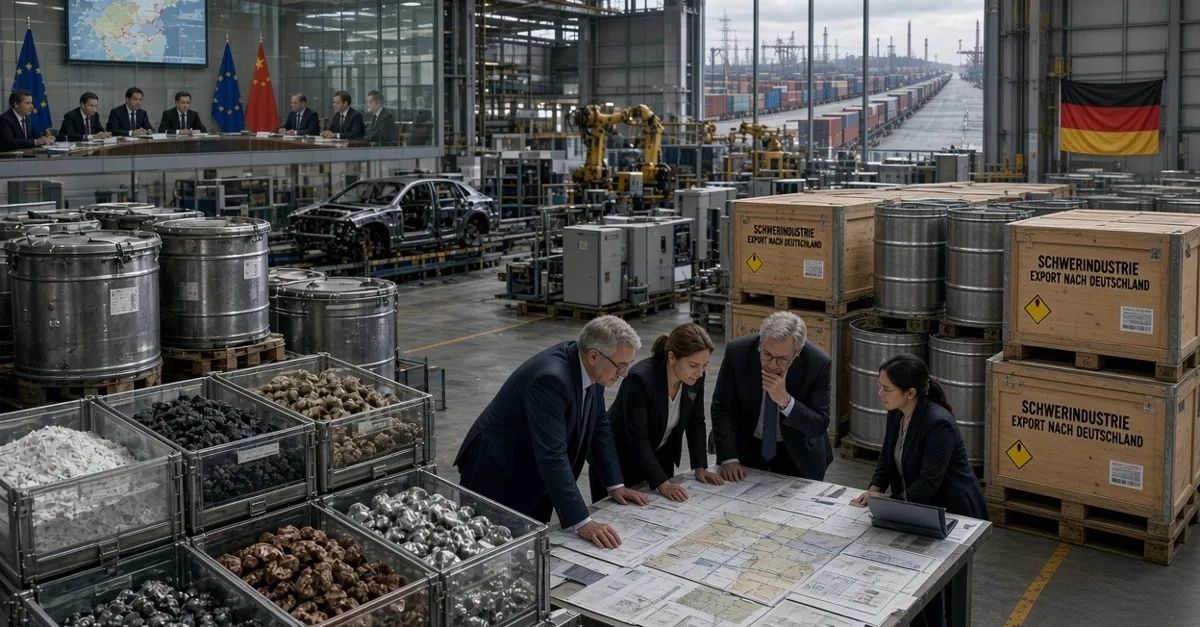
Several major German industrial companies are rushing to stockpile rare earth elements and critical raw materials. This move comes as there are growing concerns that China might limit its exports of these materials in retaliation for European trade pressures. The upcoming trade negotiations between the European Union and China, scheduled for early October, have heightened these concerns. The European Union's significant trade deficit with China, which stands at approximately one billion euros per day, is expected to be a major topic of discussion.
The European Union's trade commissioner, Maroš Šefčovič, is set to travel to Beijing on October 8-9. He will be carrying a challenging file aimed at reducing the EU's substantial trade deficit with China. Šefčovič has warned that the EU will not hesitate to impose restrictions on Chinese goods if the negotiations fail. However, this warning has sparked fears within the German industry about potential Chinese retaliation, particularly in the form of restrictions on rare earth mineral exports.
China has already taken steps that have raised concerns. In April 2024, China imposed export controls on seven rare earth elements, causing significant disruptions to several major European car manufacturers. Some companies were forced to suspend production lines, while others had to reduce their operating rates. China also announced in October that it would expand its export restrictions to include additional elements and related technologies.
The German industrial landscape is reflecting growing anxiety, with companies transitioning from caution to proactive measures. An unnamed industry official revealed that companies are adopting a policy of intensive stockpiling, with some having started early and amassed enough stock to last several months. However, most companies are not in this comfortable position, and production could come to a complete halt if export restrictions are tightened.
Matthias Roth, CEO of Tradium, a company specializing in rare earth mineral trading, described the European situation as precarious. He stated that Europe is trying to show strength it does not actually possess. When dealing with a partner of China's size, a realistic assessment of Europe's actual position is necessary. The stark reality is that China dominates the global rare earth market, controlling about 60% of global mining and nearly 90% of refining capacity.
The potential impact of Chinese export restrictions on Europe is substantial. According to the European Council on Foreign Relations, the EU's automotive industry is 100% dependent on Chinese-made permanent magnets. The International Energy Agency estimates that if China implements its export controls in full, Europe and the US could face direct losses exceeding $1.5 trillion.
In response to these challenges, China has agreed to extend its suspension of additional export controls on rare earth minerals until January. This move highlights the interconnectedness of the US and European files with China. As trade tensions escalate, both European and American industries are bracing for potential disruptions to their supply chains.
Key points
- Germany is stockpiling rare earth minerals due to fears of Chinese export restrictions.
- The EU's trade deficit with China is approximately one billion euros per day.
- China controls about 60% of global rare earth mining and 90% of refining capacity.