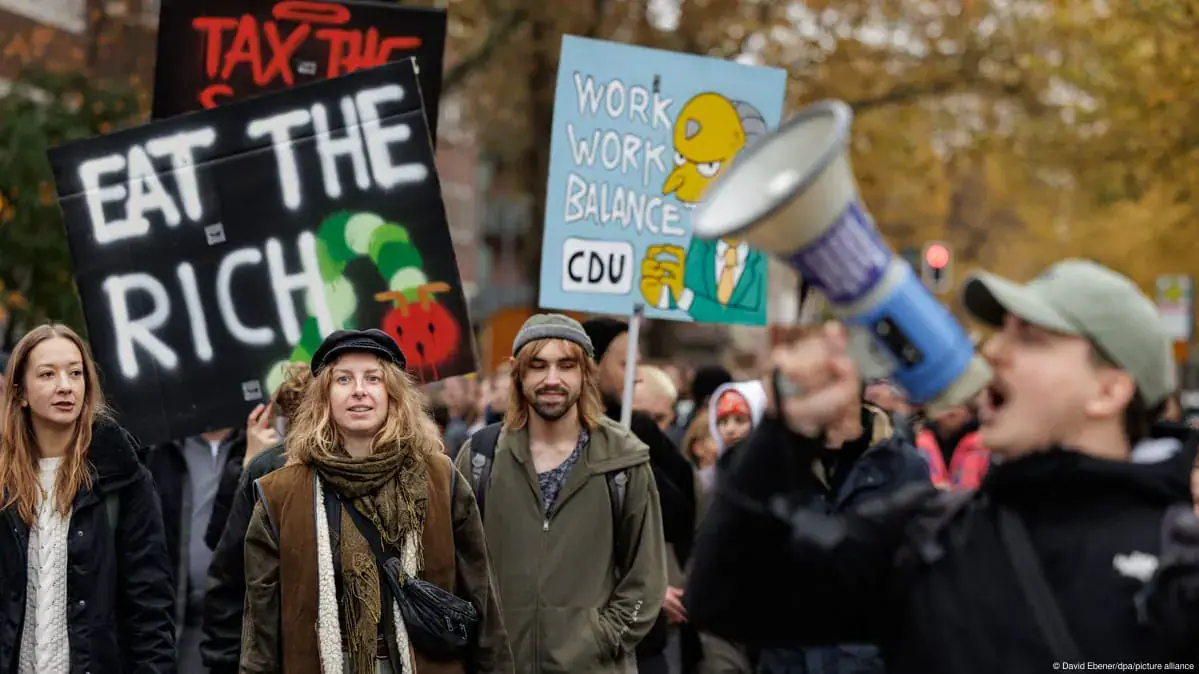
Protests are escalating in Germany and Europe as young people express growing anxiety about their future. The statistics and studies are putting "Generation Z" and the "baby boomer" generation face-to-face with rapid economic, social, and climate change. This raises fundamental questions about the fairness of burden distribution and the social system's ability to withstand the pressure.
The researcher in charge of the annual study "Youth in Germany", Simon Schnitzer, emphasized that the two generations share the same fate. He stressed the need for their efforts to be combined to formulate constructive measures that guarantee prosperity for all. Schnitzer questioned whether the state has provided young people with the necessary environment to live and work with confidence to continue financing the social protection system.
Data from the German Pension Insurance Association showed a sharp decline in the ratio of young people financing retirees. The rate fell from 3.73 contribution payers per retiree in 1957 to 2.1 people in 2025. It is expected to drop to 1.73 by 2045. In this equation, 35.35 million contribution payers bear the burden of 16.82 million retirees.
The data also revealed that annual support for the pension system is approximately 118 billion euros, equivalent to a quarter of the federal budget. There was a surge in the number of retirees benefiting from basic social security benefits. The number grew from 257,000 people in 2003 to 738,000 people in 2024. This is due to insufficient pensions to cover living costs.
A report by the German Institute for Economic Research found that the share of rent expenditure among low-income households rose from around 24% in 1990 to nearly 36% in 2021. This exceeds the spending of high-income households by 14 percentage points. Data from 2025 shows that 11% of the population allocates more than 40% of their available income to housing. This ratio increases to 35% among those threatened by poverty.
Real estate platform JACASA predicts that the market will improve in the future. This is with the transfer of ownership of around 4.8 million properties owned by the baby boomer generation through sale, inheritance, or transition to senior housing. A government report on education financing revealed that public spending on those under 30 has doubled since 2011. It reached around 8,000 euros per person per year, compared to 4,000 euros previously.
The German Statistical Office reported that education spending accounted for 4.6% of GDP in 2022. This is compared to an average of 4.7% within the Organisation for Economic Co-operation and Development. The Minister of Education and Culture Conference estimated a shortage of around 27,000 teachers by 2035. This is due to the retirement of the baby boomer generation and declining birth rates.
Key points
- Germany's youth and retirees face a deepening social and climate crisis.
- The country's pension system is under pressure, with a sharp decline in the ratio of young people financing retirees.
- The German government is increasing public spending on education and social security to address these challenges.