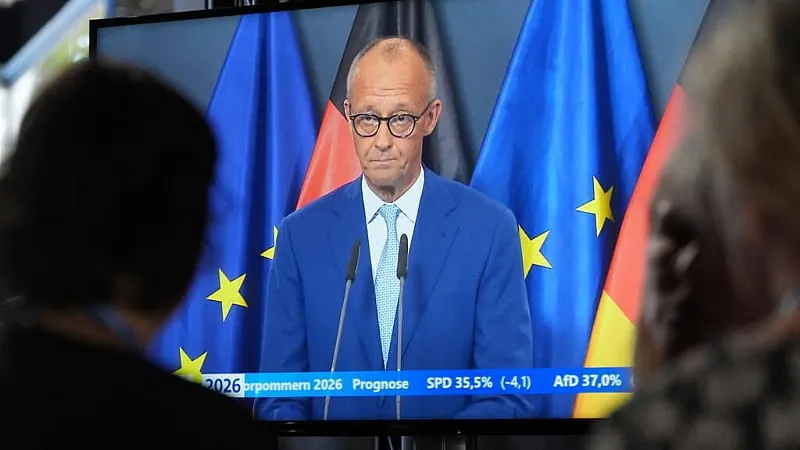
Recent regional elections in Germany's northeastern state of Mecklenburg-Western Pomerania and the capital Berlin have resulted in significant losses for Chancellor Friedrich Merz's Christian Democrats. The elections, which took place on Sunday, September 20, 2026, saw the far-right Alternative for Germany (AfD) party make substantial gains, becoming the strongest party in Mecklenburg-Western Pomerania. Merz, who has been facing pressure to address the country's economic woes and high living costs, described the outcome as a "disaster".
The losses suffered by Merz's Christian Democrats have raised questions about his position within the party and his ability to deliver on promised reforms. With an approval rating of just 17 months into his job, Merz is under pressure to resign. However, he has signaled that he will stay on and continue with his reform agenda. The AfD's gains have been attributed to its pledges of tough action on deporting foreigners with no right to stay in Germany, as well as its proposals on energy and conservative values.
The AfD's success in the elections has also raised concerns about the potential for coalition-building challenges. With the party's growing momentum and voters splitting across multiple parties, stable majorities are becoming increasingly difficult to achieve. In Mecklenburg-Western Pomerania, a future government would likely require a coalition of three parties. This has led to speculation about potential coalition arrangements, including a possible alliance between the Social Democratic Party and the Greens.
Economic anxiety played a significant role in the elections, with voters expressing frustration about high living costs and economic uncertainty. The AfD's proposal to revive the Nord Stream gas pipeline from Russia resonated with voters in Mecklenburg-Western Pomerania, who are concerned about energy costs. In Berlin, the Left Party's focus on the city's housing shortage and pledge to build affordable new homes struck a chord with voters.
The elections also saw significant gains for the hard-left party Die Linke, which drew support from frustrated voters drifting away from the mainstream. According to polling data, Die Linke attracted 28,000 voters from Merz's Christian Democrats and 45,000 from the centre-left Social Democratic Party in Mecklenburg-Western Pomerania. The party's increasing appeal among the Social Democratic Party's traditional working-class base has raised concerns about the potential for further fragmentation.
The results of the elections have also highlighted the challenges facing Chancellor Merz in terms of maintaining unity within the European Union. With far-right parties gaining momentum across the continent, Merz's weakened position as leader of the EU's largest and most powerful member could undermine unity in the bloc. The elections have also raised questions about the viability of the "firewall" strategy, which has been used to keep the AfD from power.
In the aftermath of the elections, coalition-building efforts are underway in both Mecklenburg-Western Pomerania and Berlin. In Mecklenburg-Western Pomerania, the Social Democratic Party is likely to form a coalition with the Greens, while in Berlin, the Left Party could form a majority with the Social Democratic Party and the Greens. The outcome of these efforts will have significant implications for the future of German politics and the country's ability to address its economic and social challenges.
Key points
- The far-right Alternative for Germany party made significant gains in the recent regional elections.
- Chancellor Friedrich Merz's Christian Democrats suffered losses in the elections.
- The elections highlighted the challenges facing Germany in terms of coalition-building and addressing economic anxiety.