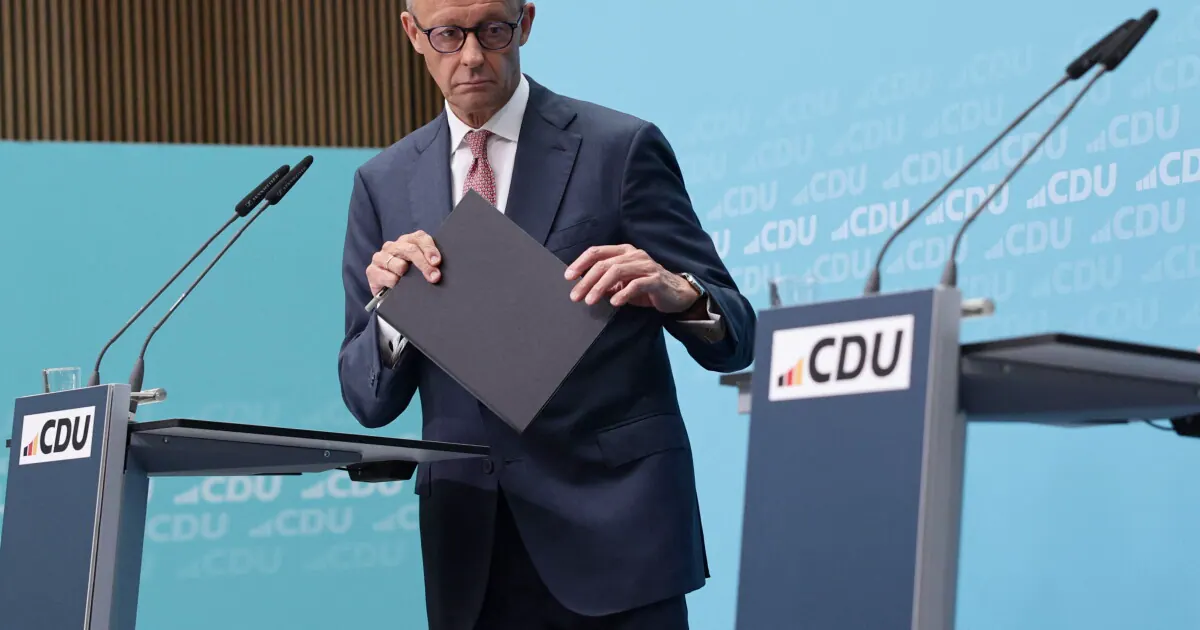
Germany's political landscape is undergoing a significant shift, with the far-right and far-left parties gaining momentum in recent elections. The center-right Christian Democrats, led by Chancellor Friedrich Merz, suffered a crushing defeat in the Berlin elections, marking their worst-ever result in a state election. This development has raised concerns about the country's stability and economy, as the political center struggles to stay relevant.
The rise of far-right and far-left parties has led to increased political fragmentation, making it challenging to form viable coalitions. Pensioner Ute Istock, who recently voted for the far-left Die Linke party, feels that the centrist parties are out of touch with voters' concerns. She believes that the proliferation of parties and the difficulty in forming majorities have made voting a tricky affair. Istock's sentiments are echoed by many German voters who feel that the political center no longer represents their interests.
Chancellor Merz has acknowledged the challenges facing the political center, citing declining trust in state institutions and the exploitation of this trend by radical parties on both the left and right. He has also recognized the need for the center-right Christian Democrats to adapt and connect with voters on an emotional level. Merz has announced plans to push ahead with tax and welfare reforms aimed at jumpstarting Germany's economy, but his messaging has been criticized for being too negative.
Communications adviser Maximilian Flügge attributes the narrowing of debate and the shrinking political center to social media algorithms, which prioritize outrage and controversy over nuance and compromise. He believes that the political center's reliance on nuanced messaging makes it difficult to compete with the far-right and far-left parties, which often employ more emotive and simplistic rhetoric.
The far-right Alternative for Germany (AfD) has been a significant beneficiary of the current political trend, winning a landslide victory in state elections in Saxony-Anhalt. The party's leader, Alice Weidel, claims that the AfD is now Germany's new big tent party, attracting voters from across the political spectrum. However, the party's policies, including its "remigration" plan, have been widely criticized.
Chancellor Merz has been vocal in his criticism of the AfD's policies, describing "remigration" as a synonym for ethnic cleansing based on origin and skin color. His comments were met with applause from lawmakers, but also sparked jeers from the AfD opposition. The exchange highlights the deep divisions in German politics and the challenges facing the political center in its efforts to regain relevance.
As Germany's political landscape continues to evolve, the country's economy and stability remain significant concerns. The political center's ability to adapt and connect with voters will be crucial in determining the country's future trajectory. Chancellor Merz's commitment to pushing ahead with reforms and finding ways to emotionally engage with voters will be closely watched, as will the rise of the far-right and far-left parties and their impact on German politics.
Key points
- Germany's political center is struggling to stay relevant amid gains by far-right and far-left parties.
- The rise of far-right and far-left parties has led to increased political fragmentation and challenges in forming viable coalitions.
- Chancellor Friedrich Merz has announced plans to push ahead with tax and welfare reforms aimed at jumpstarting Germany's economy.