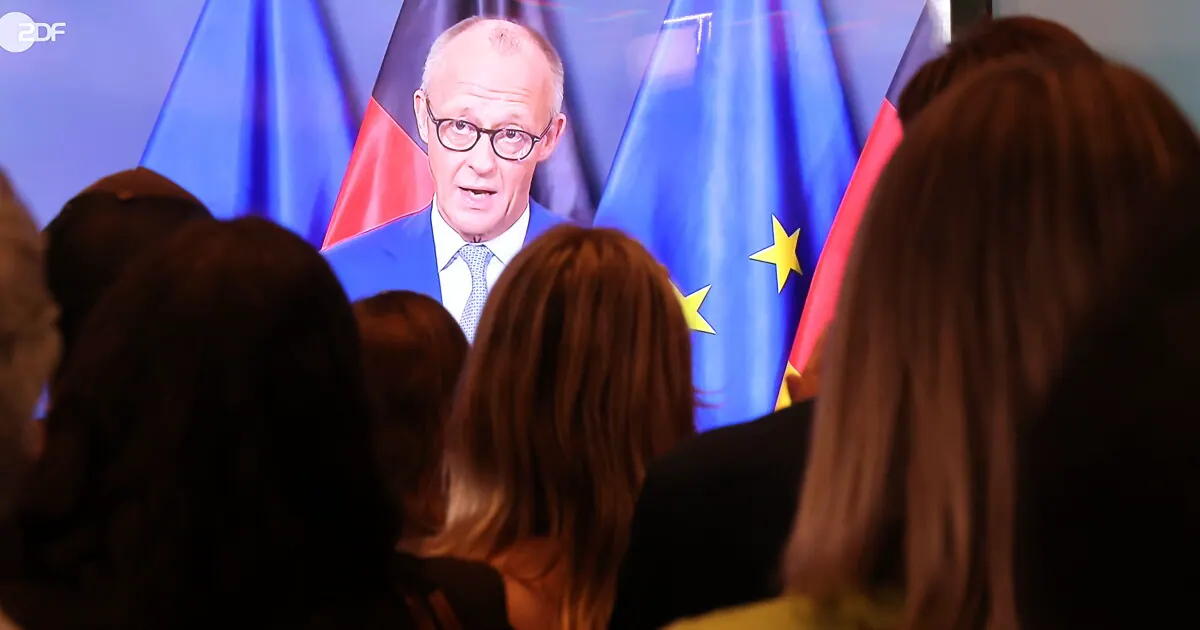
On September 18, 2026, Germany's Christian Democratic Union (CDU) party faced significant losses in state elections held in Mecklenburg-Western Pomerania and Berlin. The party's leader, Friedrich Merz, was expected to attend the United Nations General Assembly in New York but instead addressed his party's headquarters in Berlin. Exit polls revealed the CDU's worst results since World War II, with the far-right Alternative for Germany (AfD) making substantial gains.
In Mecklenburg-Western Pomerania, the AfD secured 38.2% of the vote, while in Berlin, they received 16.3%. The CDU failed to clear the 5% threshold in Mecklenburg-Western Pomerania, garnering only 4.9% of the vote. In Berlin, the far-left Die Linke party emerged as the largest party with 25.7% of the vote, seven percentage points ahead of the CDU. These results have raised concerns about Merz's leadership and the CDU's future.
Despite the losses, Merz resisted calls for his resignation, stating that he would push ahead with his federal agenda, including tax and welfare reforms. He described these reforms as "the antidote to the poison of authoritarianism" and emphasized the need for "backbone, steadfastness, and patience." Merz's decision to stand firm has been met with criticism from some within his party and the opposition.
The AfD's success in the state elections has been attributed to its ability to capitalize on voter dissatisfaction with the mainstream parties. AfD leader Alice Weidel criticized Merz, stating that he is "dragging the party down" and that his continued leadership is detrimental to the CDU. The AfD's gains have also been seen as a challenge to Merz's coalition partner, the Social Democrats (SPD).
In Mecklenburg-Western Pomerania, the AfD beat the SPD, but it is unlikely to find coalition partners to form a government. Incumbent SPD state governor Manuela Schwesig, who came in second with 35% of the vote, is expected to find the necessary allies to remain in office. In Berlin, Die Linke leader Elif Eralp pledged to make the city more affordable, drawing comparisons with New York Mayor Zohran Mamdani.
Eralp's party, Die Linke, achieved its best-ever result in Berlin with 25.7% of the vote. She plans to introduce a rent cap and seize apartments owned by large corporate real estate developers, a move that could prove contentious. To take office as mayor, Eralp needs to form a government with at least two other parties, which will require coalition negotiations.
Merz's ability to maintain his position as chancellor despite his party's losses has been attributed to the difficulty of ousting a chancellor in Germany. According to Sudha David-Wilp of the German Marshall Fund, Merz is unlikely to step down, given his long-held ambition to be chancellor and the high bar for removal.
Key points
- Merz resists calls for resignation after CDU's significant losses in state elections.
- AfD makes substantial gains in Mecklenburg-Western Pomerania and Berlin.
- Die Linke achieves best-ever result in Berlin, with Elif Eralp pledging to make the city more affordable.