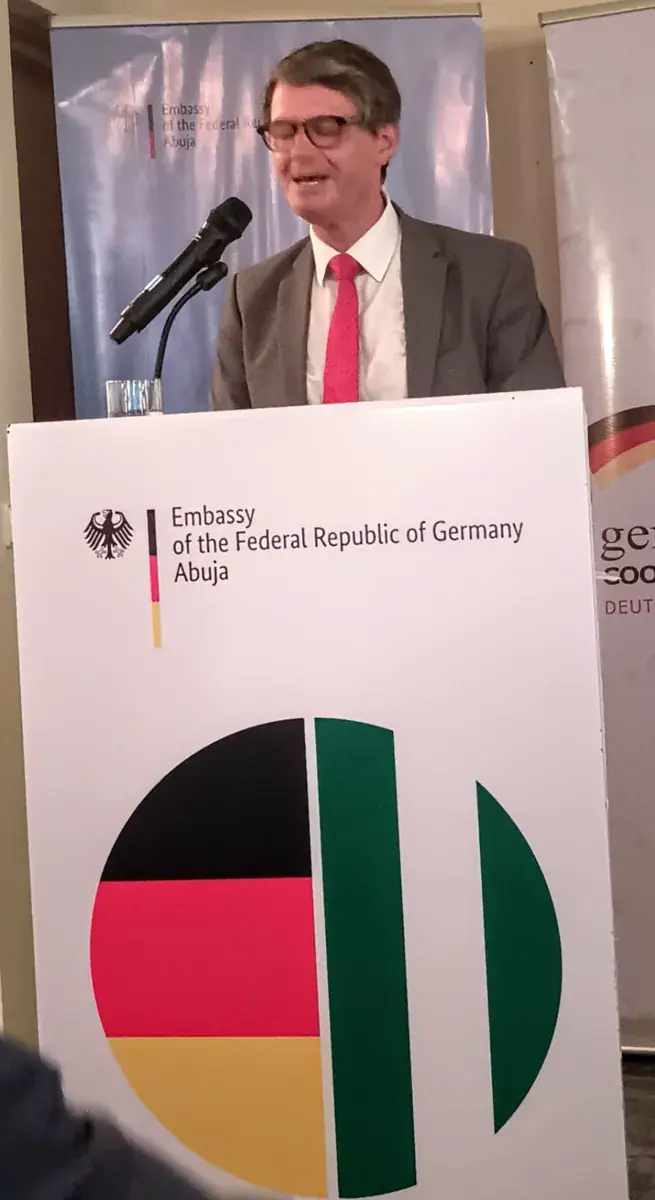
Germany's trade volume with Nigeria has exceeded 3 billion euros in 2025, marking a 20% increase from the previous year. This significant growth was announced by German Ambassador to Nigeria, Mr Stefan Rossel, at a reception in Abuja celebrating the 2026 German Unity Day. The Ambassador highlighted the strong and expanding relations between both countries, with opportunities for deeper cooperation in various sectors.
Ambassador Rossel, who assumed office in Nigeria two months ago, identified energy, mining, machinery, and agriculture as priority sectors for increased German investment. He emphasized that Germany remains Nigeria's largest development partner, with development cooperation valued at over 658 million euros. This partnership aims to promote sustainable economic development, vocational training, employment generation, agricultural transformation, and energy transition.
The German Ambassador reaffirmed his country's commitment to supporting Nigeria's efforts to combat terrorism and organized crime. He disclosed that the two countries maintain regular military exchanges, while the German Armed Forces Advisory Group provides specialized training in tactical medicine and the detection of improvised explosive devices. Germany has invested nearly 190 million euros in joint stabilization efforts in Nigeria and the Lake Chad region.
Germany's support for Nigeria extends to the security sector, with a focus on reforms in the Nigeria Police Force since 2021. The Ambassador highlighted the importance of security cooperation between both countries, emphasizing that it is crucial for economic prosperity and national stability. This cooperation is part of a broader partnership that includes trade, investment, education, and climate action.
Reflecting on German Unity Day, Ambassador Rossel described the 1990 reunification of East and West Germany as a defining moment that demonstrated the importance of freedom, peace, and unity in national development. He drew parallels between European integration and the Economic Community of West African States (ECOWAS), noting that both regional blocs have grown beyond economic cooperation to broader partnerships based on shared values.
On democratic governance, Ambassador Rossel emphasized the importance of the rule of law, accountability, transparency, and judicial independence. He described these elements as critical to economic prosperity, investor confidence, and national stability. The Ambassador urged Nigeria and Germany to sustain their longstanding partnership, expressing optimism that stronger cooperation and shared commitment would create more opportunities for both countries.
The strong bilateral relations between Germany and Nigeria are expected to continue growing, with a focus on mutually beneficial cooperation. The partnership between both countries has the potential to drive economic growth, improve security, and promote sustainable development. As Germany continues to support Nigeria's development, both countries are likely to explore new opportunities for collaboration in various sectors.
Key points
- Germany and Nigeria's trade volume exceeded 3 billion euros in 2025, representing a 20% increase from the previous year.
Reporting sources
- Germany-Nigeria Trade Volume Exceeds 3b Euros · Kapital FM