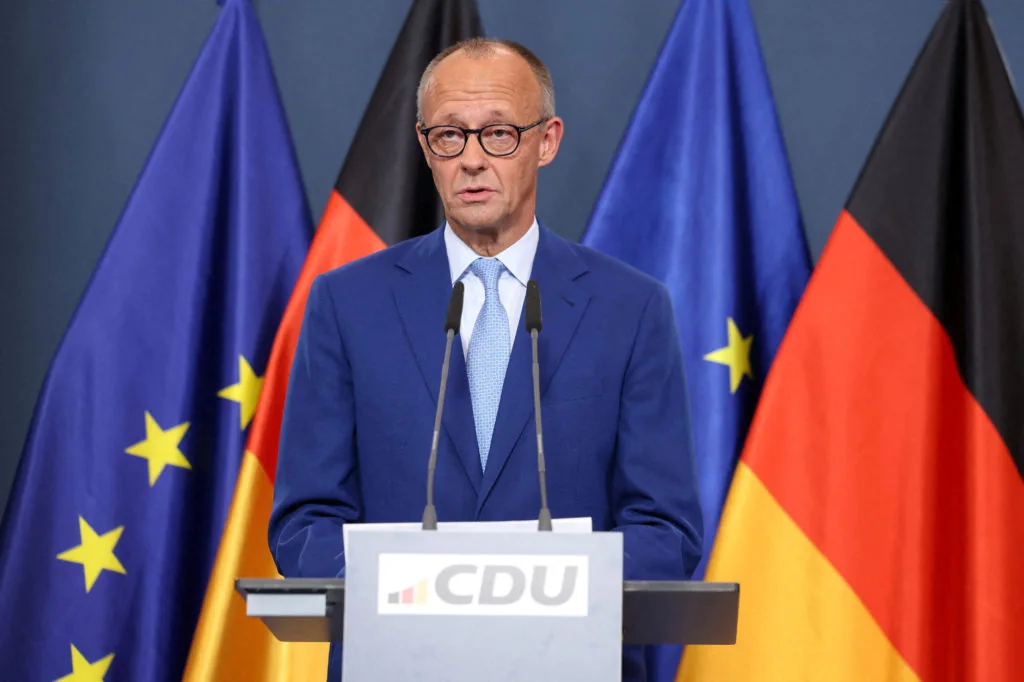
German Chancellor Friedrich Merz has vowed to remain in office despite suffering significant election defeats in two states, Berlin and Mecklenburg-Vorpommern. The Christian Democratic Union (CDU) party, led by Merz, was projected to scrape into parliament in Mecklenburg-Vorpommern with its worst-ever election result. In Berlin, the ruling CDU was expected to be beaten by Die Linke (The Left). Merz described the results as "a disaster" for his party.
The election results have piled pressure on Merz, who has been struggling with poor approval ratings and rumors of a potential mid-term replacement. The CDU's poor performance comes after a series of disappointing results, including a major victory for the far-right Alternative for Germany (AfD) in the state of Saxony-Anhalt two weeks ago. Merz has long coveted the top job in German politics and is unlikely to give it up easily.
In a statement at the CDU's Berlin headquarters, Merz insisted that he would push through with his coalition government's plans to implement economic, tax, and welfare reforms. He emphasized that the reforms were crucial for moving the country forward and that he was committed to taking on the responsibility. Merz's determination to stay on comes despite growing speculation about his future as chancellor.
The projected results showed the AfD taking 38% of the vote share in Mecklenburg-Vorpommern, followed by the centre-left Social Democratic Party (SPD) on 36%. The CDU was on 5% of the vote, marking a significant decline in support. In Berlin, the CDU was projected to secure 20% of the vote share, behind Die Linke on nearly 26%. The AfD also looked set to increase its vote in Berlin, with a projected 16% of the vote.
Merz's decision to stay on has been backed by some CDU members, including Burkard Dregger, a CDU member of the Senate in Berlin. Dregger argued that Merz had a lot of work to do and that it was unrealistic to expect all issues to be solved within a year. He emphasized that Merz had four years to make a difference and that the party should give him the opportunity to do so.
However, Merz's popularity has been a challenge, with his shift to the right on issues like immigration failing to erode AfD support while alienating people further to the left. The CDU's struggles have raised questions about Merz's leadership and the party's ability to regain the trust of voters. Despite these challenges, Merz remains committed to his role as chancellor and CDU party chairman.
The final results of the elections are expected to be announced later on Sunday night or Monday morning. Merz's ability to navigate the challenges facing his party and the country will be closely watched in the coming months. His determination to push through with reforms and his refusal to step down have set the stage for a critical period in German politics.
Key points
- German Chancellor Friedrich Merz resists calls to step down after dismal election results for his Christian Democratic Union party in Berlin and Mecklenburg-Vorpommern.
- The CDU's poor performance has piled pressure on Merz, who has been struggling with poor approval ratings and rumors of a potential mid-term replacement.
- Merz remains committed to pushing through with his coalition government's plans to implement economic, tax, and welfare reforms despite growing speculation about his future as chancellor.