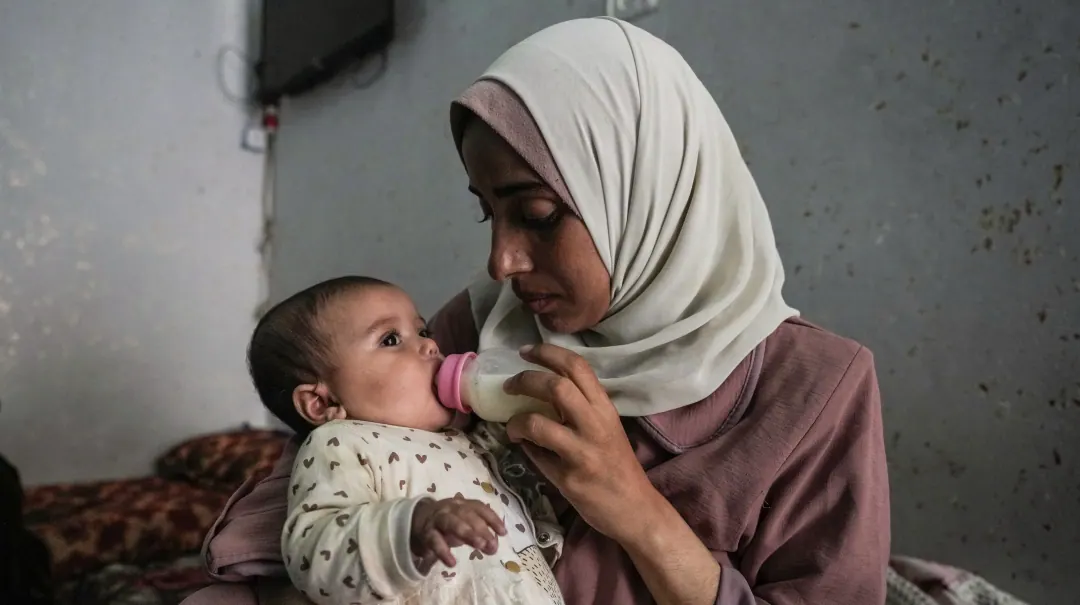
The war in Gaza has severely impacted the ability of mothers to breastfeed their infants, with thousands of babies struggling to access breastmilk. Shireen Al-Khatib, a 36-year-old mother, had to wean her child off breastmilk after just over a year due to food shortages and her own declining health. Al-Khatib relies on aid and charity food, which is often of poor nutritional value.
The lack of nutritious food has weakened the ability of many mothers to produce breastmilk, while the high cost of formula milk has made it inaccessible to many. According to the Gaza Ministry of Health, the percentage of mothers breastfeeding their infants for the first six months has dropped to 20%. The ministry also reported that 59% of Gaza's population suffers from food insecurity, with 74,000 children and 25,000 pregnant and breastfeeding women at risk of severe malnutrition.
One mother, Lamiss Issa, had to resort to formula milk for her five-month-old baby after he began to suffer from malnutrition. However, the cost of formula milk has skyrocketed since the war, with a single can now costing 45 shekels, up from 8-12 shekels before the conflict. Issa has had to take on debt to provide for her child, highlighting the struggles faced by many families in Gaza.
The lack of access to clean water and sanitation has also made it difficult for mothers to prepare formula milk safely. According to the UN Office for the Coordination of Humanitarian Affairs (OCHA), over 20,000 women have been screened for malnutrition, with many requiring supplementary feeding. The Integrated Food Security Phase Classification (IPC) has also warned that 24,600 pregnant and breastfeeding women will require urgent food assistance.
Experts have accused Israel of deliberately introducing low-nutrition food into Gaza, while restricting the entry of essential food items. Economist Ahmed Abu Qamar has called for the introduction of fresh food, such as fruits and vegetables, into Gaza's aid supplies. He argues that this would provide the necessary nutrition for mothers and their children.
The consequences of malnutrition in Gaza are dire, with 165 children dying from hunger and malnutrition-related illnesses since the start of the war. The Gaza Government Media Office has also reported that nearly 4,441 cases of miscarriage have been recorded due to the lack of healthcare and poor nutrition. Health experts have warned that the situation is likely to worsen without urgent intervention.
In response to the crisis, the Gaza Ministry of Health has launched a campaign to promote breastfeeding and provide education on its importance. However, with limited resources and the ongoing conflict, it remains to be seen whether these efforts will be enough to address the scale of the problem.
Key points
- Thousands of infants in Gaza are struggling to access breastmilk due to food shortages and the high cost of formula milk.
- The lack of nutritious food and clean water has weakened the ability of mothers to produce breastmilk, with severe consequences for infant health.
- Experts have accused Israel of deliberately restricting the entry of essential food items into Gaza, exacerbating the crisis.