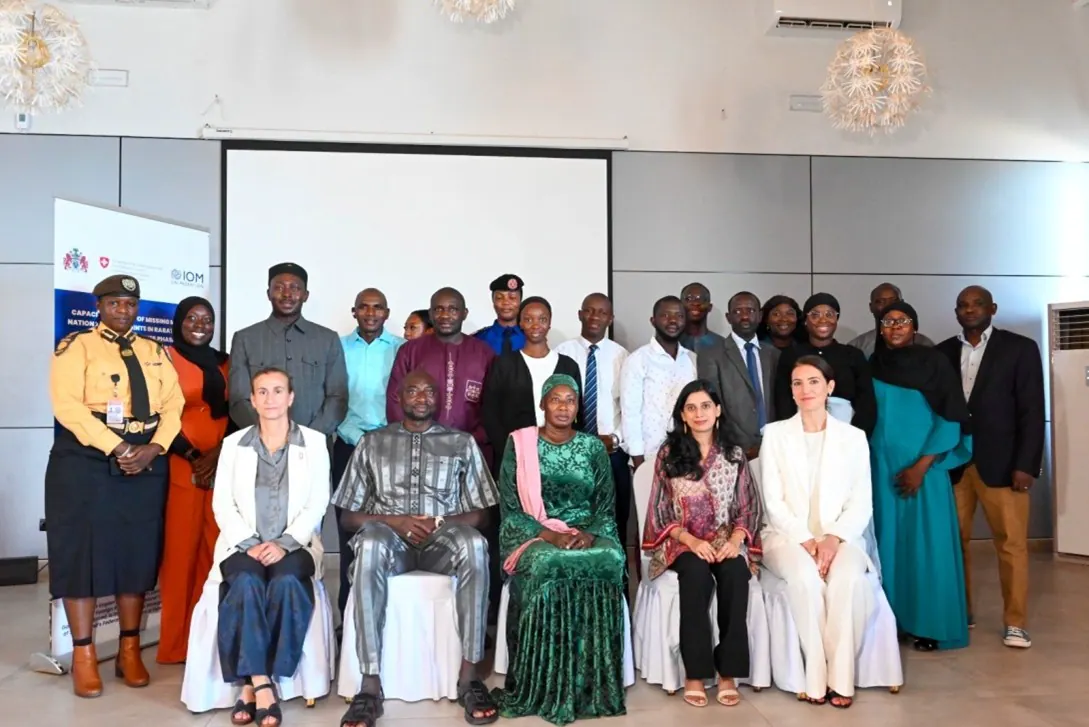
The Gambia has taken a significant step towards preventing migrant deaths and disappearances by hosting a three-day Foundational Training Course on Missing Migrants. The course, which commenced on Wednesday, brings together government officials, law enforcement agencies, humanitarian organizations, and civil society stakeholders. The training aims to enhance search and identification mechanisms, improve case management, and promote coordinated support for families of missing migrants.
The International Organization for Migration (IOM) in collaboration with the Ministry of Foreign Affairs, International Cooperation and Gambians Abroad (MoFA) organized the training under the project "Capacity Building of Missing Migrants National Focal Points in Rabat Process Partner Countries (Mauritania and The Gambia)". The project is funded by the Swiss Federal Department of Foreign Affairs. During the three-day course, participants will engage in discussions on good practices, policy frameworks, and collaborative approaches to addressing missing migrant cases in The Gambia and beyond.
According to IOM's Missing Migrants Project, at least 250 Gambians have gone missing along migration routes since 2014, although the actual figure is likely higher. Sibgha Ajaz, IOM The Gambia's Officer-in-Charge, noted that The Gambia has increasingly positioned itself as a regional leader on missing migrants through its engagement in the Rabat Process and establishment of the National Task Force on Missing Migrants.
Ajaz emphasized that the issue of missing migrants goes beyond statistics and policies, as every missing migrant leaves behind families searching for answers. The training aims to strengthen participants' knowledge on preventing migrant deaths and disappearances, identification, case management, family assistance, and cooperation. This initiative is crucial in addressing the humanitarian and diplomatic concerns surrounding missing migrants.
Ndumbeh Saho, Director of Migration and Diaspora at MoFA, highlighted that missing migrants represent a critical humanitarian and diplomatic issue, particularly for The Gambia where migration has significant social and economic dimensions. She stressed the importance of protecting human dignity, supporting families, and strengthening national coordination to address missing and deceased migrants.
Director Saho also emphasized the importance of Gambian diplomatic missions along migration routes and called for stronger cooperation among government institutions, civil society, and international partners. She urged participants to use the three-day training to improve coordination, information sharing, identification, family tracing, and support, while respecting human rights, confidentiality, and dignity.
The training course is expected to equip participants with the necessary skills and knowledge to effectively address the issue of missing migrants in The Gambia. The country's efforts to strengthen migration governance and enhance search and identification mechanisms are commendable. The collaboration between the IOM, MoFA, and other stakeholders is crucial in addressing this complex issue.
Key points
- The Gambia hosts a three-day training course to strengthen national capacities to prevent migrant deaths and disappearances.
- At least 250 Gambians have gone missing along migration routes since 2014.
- The training aims to enhance search and identification mechanisms, improve case management, and promote coordinated support for families of missing migrants.