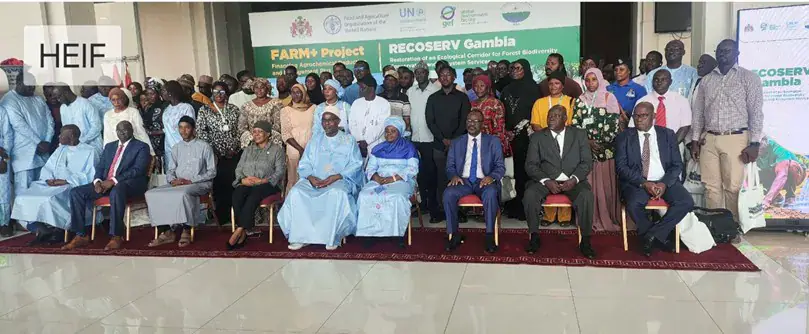
The Gambia has launched two major five-year projects aimed at restoring degraded ecosystems and transitioning to sustainable agriculture. The projects, the Great Green Wall (GGW) RECOSERV Gambia Project and the FARM-Plus Project, were launched at a ceremony held at the Sir Dawda Kairaba Jawara International Conference Center in Bijilo. These initiatives are funded by the Global Environment Facility (GEF) with technical support from the United Nations Environment Programme (UNEP) and the Food and Agriculture Organization (FAO).
The RECOSERV Gambia project under the Great Green Wall initiative seeks to restore an ecological corridor for forest biodiversity conservation. It aims to restore 43,000 hectares of degraded forest and wetland ecosystems, upgrade management across 38,000 hectares of protected areas, and introduce sustainable practices on 36,000 hectares of rural landscapes. This project is expected to benefit about 795,000 people, majority of them women, and is a significant step towards environmental sustainability in the country.
The FARM-Plus Project will strengthen policies, improve access to finance and insurance, build technical capacity, and promote sustainable value chains to help farmers transition to agroecological and climate-smart agriculture. This project is expected to empower farmers and enhance their ability to adopt sustainable agricultural practices. Minister of Agriculture Demba Sabally emphasized that the projects are a bold statement of collective resolve to restore degraded lands and empower farmers.
Speaking at the launch, NEA Executive Director Dawda Badjie said the projects represent more than just new programmes but a renewed national commitment to environmental sustainability. He stressed that the projects will help address some of the most pressing environmental challenges facing The Gambia, while building a more sustainable, productive, and climate-resilient future. The projects are a significant step towards achieving environmental sustainability and combating climate change.
FAO Country Representative Moshibudi Rampedi said the two projects will advance a greener and more resilient Gambia in line with the UN Sustainable Development Cooperation Framework. She emphasized that FAO will support farmers and extension workers to adopt alternatives that reduce harmful chemicals, conserve water, and reduce waste. This support will help farmers transition to sustainable agricultural practices and enhance their livelihoods.
Minister of Environment Rohey John Manjang called for community participation and accountability in implementation, saying success should be measured by the survival of restored forests and tangible improvement in livelihoods. Vice President Muhammed B.S. Jallow stressed that environmental protection and agricultural transformation are not competing priorities but mutually reinforcing. He emphasized that success should not be measured only by trees planted but by recovery of functioning ecosystems, biodiversity, and stronger community livelihoods.
The launch was attended by senior government officials, UN agencies, farmer associations, and development partners. The projects are a significant step towards achieving environmental sustainability and combating climate change in the Gambia. The government has demonstrated its commitment to environmental sustainability, and the projects are expected to have a positive impact on the lives of the Gambian people.
Key points
- The Gambia launches two major projects to restore degraded ecosystems and transition to sustainable agriculture.
- The projects are funded by the Global Environment Facility (GEF) with technical support from UNEP and FAO.
- The projects aim to benefit about 795,000 people, majority of them women, and enhance environmental sustainability in the country.