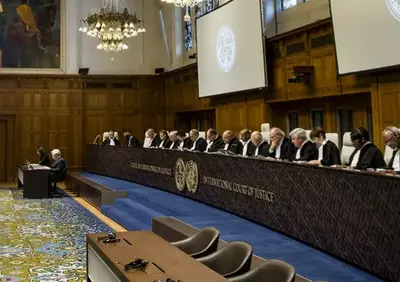
Former British MP George Galloway has praised South Africa's decision to take Israel to the International Court of Justice (ICJ) as a "second age" of the country's greatness after its liberation from apartheid. Speaking in Cape Town, Galloway said the case had made a significant contribution to humanity and should not be underestimated. He credited the South African legal team and government for pursuing the case under the Genocide Convention.
Galloway's comments were made during a media breakfast alongside British journalist Yvonne Ridley, where they discussed South Africa's international role, the destruction in Gaza, colonialism, and the responsibility of journalists. The pair were on their People Power Tour, focusing on Palestine and broader human rights issues. Galloway acknowledged that South Africans would judge their government on its domestic record but urged them to recognise the significance of its intervention on Palestine.
The ICJ has issued three binding provisional-measures orders to protect Palestinians in Gaza but has not delivered a final judgment on whether Israel has committed genocide. Israel denies committing genocide. Galloway expressed scepticism about the court's ultimate decision, saying he was "not expecting anything very much from the ICJ." He described the case as "political theatre," which he believes is powerful and important in focusing attention on Palestine and the responsibility of other countries.
Galloway argued that Israel's actions constitute genocide because of the intention to remove Palestinians from their land. He contrasted this with apartheid South Africa, where the economy depended on black people as workers and consumers. Galloway linked the destruction in Gaza to the displacement of Palestinians and the generations who had subsequently lived in refugee camps or exile. He recalled meeting a Palestinian family from Jaffa, illustrating the reach of Palestinian displacement.
Yvonne Ridley criticised Western journalism for its language and approach to reporting on Palestine. She argued that descriptions of Palestinians "losing" their children or lives obscured the violence responsible for their deaths. Ridley rejected the idea of impartiality that requires journalists to treat oppression and the experiences of those subjected to it as morally equivalent. She emphasised the importance of giving a voice to oppressed people and using language responsibly.
Both speakers urged sustained public pressure while the legal process continued. Ridley drew on South Africa's liberation history, arguing that international solidarity had sometimes been greater than people inside South Africa could see through mainstream reporting. Galloway said governments sympathetic to Palestine had a particular responsibility to use their powers to support the case. He also warned against using accusations of terrorism and anti-Semitism too broadly.
Galloway and Ridley concluded that the case had already had a significant impact, focusing attention on Palestine and the responsibility of other countries. They emphasised the importance of continued public pressure and support for the case. The international community will be watching the ICJ's final judgment, which will determine whether Israel has committed genocide under the Genocide Convention.
Key points
- South Africa's genocide case against Israel represents a "second age" of the country's greatness.
- The ICJ has issued three binding provisional-measures orders to protect Palestinians in Gaza.
- Galloway and Ridley urge sustained public pressure while the legal process continues.