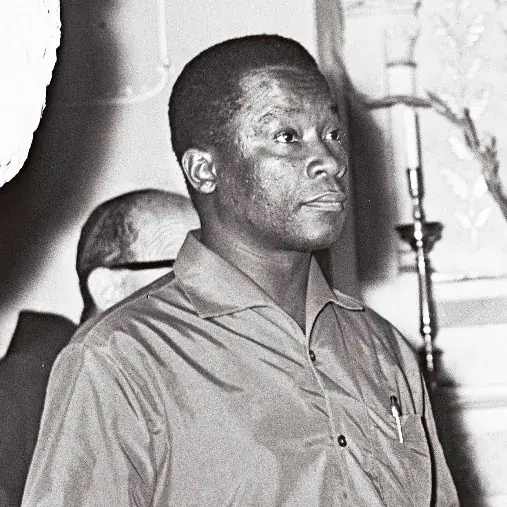
Gabriel Lisette played a crucial role in Chad's early independence, serving as one of the main architects of the country's political emancipation for nearly 15 years. His intelligence, culture, and ability to navigate different worlds made him a powerful figure, but also contributed to his fragility. Lisette's removal from power by François Tombalbaye just days after independence highlights the contradictions that defined Chad's nation-building process.
Born on April 2, 1919, in Puerto Bello, Panama, to a family of Guadeloupean fishermen and artisans, Lisette's background was marked by a complex relationship with France. As a French citizen, he was heir to a history of slavery and colonial domination, but also aware of the promises of republican universalism. Lisette studied at the Lycée Carnot in Pointe-à-Pitre and later at the prestigious Lycée Henri-IV in Paris.
Lisette's educational background also included attending the École nationale de la France d'outre-mer, which trained administrators for the colonies. This institution played a significant role in shaping his perspective on governance and his later involvement in dismantling the colonial system. Lisette's anticolonialism was rooted in his conviction that the principles of the French Republic could be used to challenge colonial practices.
In January 1959, as Lisette led the government of the young Republic of Chad, a correspondent from Le Monde reported a telling incident. When territorial councillors requested increased indemnities, Lisette reminded them of the modest incomes of their constituents, saying, "You forget that it is the sweat of the Chadians that will pay the councillors." This anecdote reveals Lisette's conception of public responsibility and his approach to exercising authority.
Lisette's leadership style was characterized by his confidence in the power of sound reasoning to inform decision-making, even if it meant going against those who depended on his majority. This approach often made him a reformer, but not necessarily a skilled politician. His eventual ousting on February 10, 1959, marked a turning point in his relationship with the Chadian government.
The complexities of Lisette's personality and politics are closely tied to his experiences as an intellectual from the French Caribbean. His story offers insights into the challenges faced by those who navigated the complexities of colonialism and nation-building in Africa. Lisette's legacy continues to be felt in Chad, where his contributions to the country's early independence remain significant.
Despite his significant contributions to Chad's independence, Lisette's time in power was marked by controversy and ultimately ended in his removal from office. His story serves as a reminder of the intricate relationships between colonialism, nation-building, and the complex individuals who shape the course of history. Lisette's impact on Chad's development continues to be studied and analyzed by historians and scholars today.
Key points
- Gabriel Lisette's leadership style was characterized by his confidence in sound reasoning and his commitment to the principles of the French Republic.
- Lisette's complex background, marked by his Caribbean and French education, influenced his perspective on colonialism and nation-building.
- Lisette's removal from power highlights the contradictions that defined Chad's nation-building process and the challenges faced by those who navigated the complexities of colonialism and independence.
Reporting sources
- Gabriel Lisette, l’homme qui avait choisi le Tchad · Le Ndjam Post