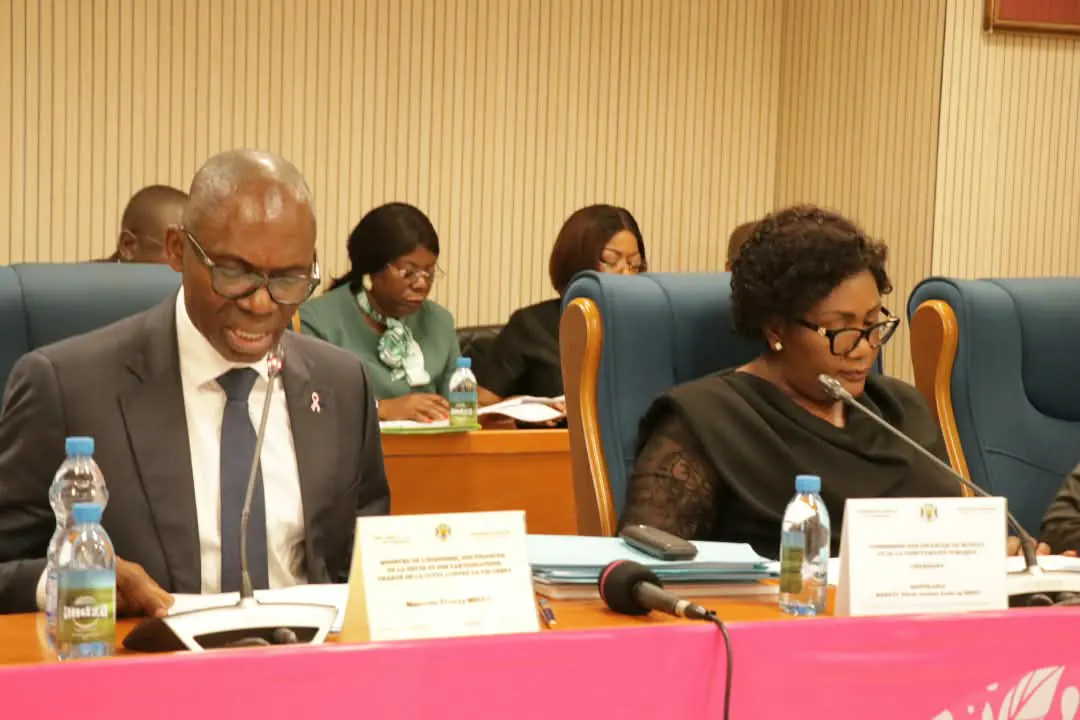
On October 8, the Gabonese Minister of Economy, Finance, Debt, and Participations, Thierry Minko, appeared before the National Assembly to discuss the 2025 budget regulation bill. He was accompanied by Minister of Planning and Prospective Louise Pierrette Mvono. The presentation provided a detailed overview of the management of budget envelopes for the 2025 fiscal year, revealing a mixed performance across different sectors.
The report highlighted significant variations in budget execution across various missions. For Mission 14, which focuses on public finance management, the initial budget was 77.1 billion FCFA, but the actual disbursements and payments were 816.5 billion FCFA and 796.6 billion FCFA, respectively. This resulted in a substantial discrepancy of 719.4 billion FCFA. The minister attributed this largely to the exceptional inclusion of the entire public sector's payroll under this mission.
In contrast, Mission 35, which includes state commitments such as debt servicing, petroleum price support, and anti-poverty measures, showed a near-total execution rate of 98.2%. The government disbursed 543.3 billion FCFA out of an initial 553.4 billion FCFA allocated for these critical areas. However, the performance was less impressive for Mission 30, which covers transversal expenditures. Despite an initial allocation of 225.2 billion FCFA, only 110.9 billion FCFA was disbursed and 65.3 billion FCFA was actually paid out, reflecting a payment rate of just 29%.
The presentation sparked significant reactions from parliamentarians, who expressed concerns over the discrepancies and low execution rates in certain areas. Huguette Tsono, the sixth vice-president of the National Assembly, called for enhanced budget transparency to address the recurring irregularities observed year after year. Armelle Yembi Yembi, a deputy, urged the government to reverse the trend of under-execution, emphasizing the urgency of addressing the needs of the population.
The debate was characterized by a call for pragmatic action over theoretical discussions. The President of the National Assembly, Michel Régis Onanga M. Ndiaye, encouraged both government members and lawmakers to focus on concrete results. He referenced the pragmatic approach advocated by the Head of State, urging a departure from mere rhetoric.
The examination of the 2025 budget regulation bill is set to continue within the specialized commissions of the National Assembly. The discussions are expected to scrutinize the budget execution and explore ways to improve financial management and transparency. The outcome of these deliberations will be crucial in shaping Gabon's economic policies and budgetary allocations.
The mixed performance of the 2025 budget has underscored the need for more effective financial management and accountability. As the National Assembly continues its review, stakeholders are looking for commitments to enhance transparency and efficiency in budget execution. The government's ability to address these concerns will be critical in fostering confidence and ensuring that budgetary resources are utilized optimally for the country's development.
Key points
- The Gabonese government has presented a mixed budget report for 2025, with significant discrepancies in budget execution across various sectors.
- The report highlighted a near-total execution rate for state commitments but low execution rates for transversal expenditures.
- Parliamentarians have called for enhanced budget transparency and a reversal of under-execution trends to address the needs of the population effectively.