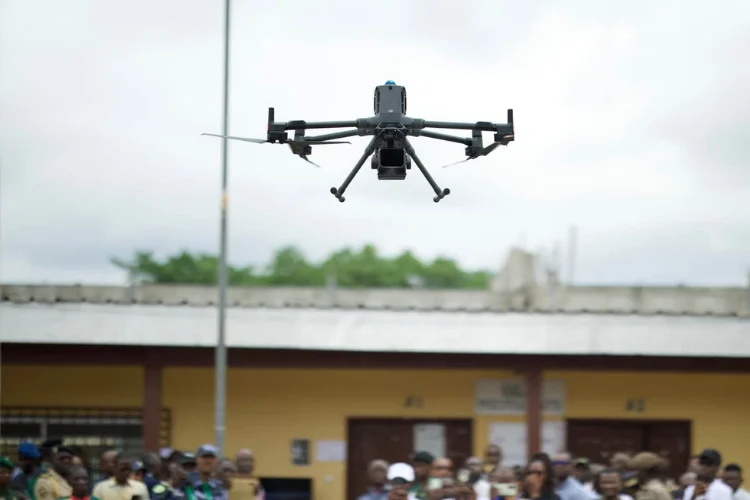
The Gabonese government is turning to high-tech drones and satellites to regain control of its territory. At the first edition of the Gabon Drone Expo, held on September 24 and 25, 2026, Nicolas Adias, CEO of Drone Hub, highlighted the sovereignty issues driving the country's massive investment in drone technology. The event took place at the National School of Technology and Applied Sciences (ENSET).
According to Adias, Gabon loses approximately $15 million (9.9 billion FCFA) annually due to illegal logging, which is compounded by inadequate maritime surveillance. The country's dense cloud cover hinders the effectiveness of traditional optical satellites. Drones, capable of flying under clouds and providing near-real-time information, are being used to bridge this gap.
The Gabonese Agency for Space Studies and Observations (AGEOS) is already utilizing drones to enhance satellite detections. Drones help characterize forest clearings, which is crucial for monitoring and conservation efforts. This technology is also being applied to track artisanal gold mining, monitor urban construction sites in Libreville, and detect coastal pollution.
The use of drones and satellites offers a complementary approach to territorial control. Satellites operate at high altitudes, covering vast areas, while drones provide targeted, rapid, and cost-effective interventions at lower altitudes. This integrated approach enables more effective monitoring and management of Gabon's resources.
Beyond territorial control, drones are seen as a means to create employment opportunities for Gabon's predominantly young population. Emerging industries such as drone operation, image analysis, precision agriculture, and medical logistics are being promoted by the government. The state plans to support young entrepreneurs with funding, equipment, and access to local markets.
Currently, Gabon relies entirely on foreign providers for satellite services, as it does not have any satellites in orbit. However, a project to acquire national satellites is underway, driven by the president's desire for full technological sovereignty. This move is part of a broader effort to leverage high-tech tools in various sectors.
The push for technological sovereignty is driven by the understanding that modern conflicts are increasingly fought with data and high-tech tools. By investing in drones and satellites, Gabon aims to enhance its capabilities in resource management, security, and economic development. The government hopes that this strategic investment will yield long-term benefits for the country's growth and stability.
Key points
- Gabon loses $15 million annually due to illegal logging and inadequate maritime surveillance.
- The country is investing in drone technology to bridge the gap in territorial control and surveillance.
- The government sees drones as a means to create employment opportunities for young people in emerging industries.