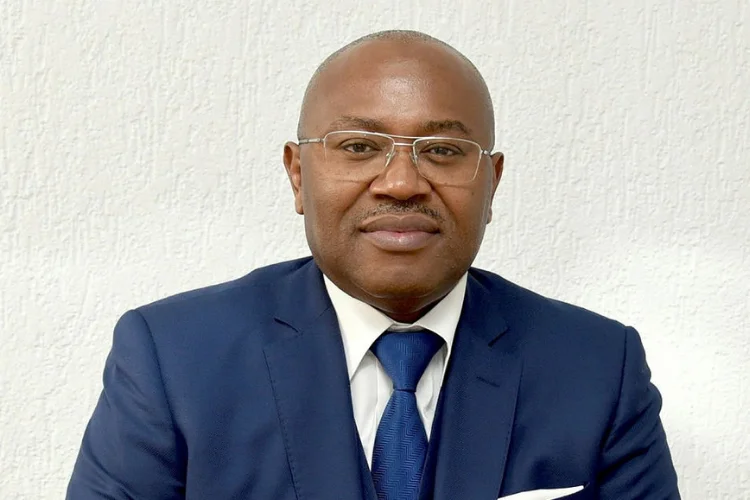
Jean-Fidèle Otandault, a renowned expert-comptable and former Gabonese Minister of State, stresses that an economy progresses when it can renew itself. Based on the works of Nobel laureate Philippe Aghion, Otandault believes that artificial intelligence can boost productivity for Gabonese enterprises and workers. This could benefit Gabon's economy, which remains heavily reliant on a few key resources. Otandault's insights follow his attendance at Aghion's conference on "creative destruction," a concept that highlights the importance of innovation in driving economic growth.
The idea of "creative destruction" implies that economic growth is not solely about producing more, but also about inventing new ways of producing, new services, and new industries. Otandault illustrates this concept with the example of mobile phones, which replaced traditional phone booths but also created new manufacturers, services, and job opportunities. He applies this idea to the current context of artificial intelligence, which will automate certain tasks, transform others, and create new activities. The key is to prepare workers, enterprises, and institutions for this transition.
Otandault's own profession as an expert-comptable is not immune to the impact of artificial intelligence. While AI can automate tasks such as data entry and standard information production, it will not replace the expert-comptable's role. Instead, their value-added will shift towards interpreting information, providing advice, and supporting decision-making. Otandault emphasizes that AI will transform the nature of their work, but not necessarily reduce the need for their expertise.
Applying this thinking to Gabon's economy, Otandault notes that the country has significant assets, including oil, manganese, wood, and a strategic geographical position. However, the economy remains heavily reliant on a few resources, with oil, manganese, and wood accounting for 97% of exports in 2024. To diversify, Gabon must create new activities that will drive wealth creation in the future. This requires investing in human capital, infrastructure, energy, industry, and competitive enterprises.
Otandault stresses that diversification does not mean abandoning traditional sectors, but rather transforming the revenue and advantages generated by these sectors into other forms of wealth. The challenge is to convert Gabon's natural capital into sustainable productive capacities. This will require significant investments, but also careful management of financial balances. Otandault emphasizes the need for a balanced approach that considers the cost of financing, economic and social utility, and the impact on activity and debt sustainability.
The transformation driven by technological change can be daunting for workers, and Otandault acknowledges the need for policies that support workers who may be displaced. He advocates for a policy of innovation accompanied by training, reconversion, and professional mobility. This will enable workers to transition from declining activities to growing ones, ensuring social acceptability of change. This issue is particularly pressing in Gabon, where youth unemployment remains high, around 20% of the active population.
Otandault sees potential for artificial intelligence to become an opportunity for Gabon to catch up, but emphasizes that it is not a magic solution. AI can provide small structures with access to analysis, translation, and other capabilities, but it must be harnessed in a way that creates jobs and drives growth. The role of public policies is crucial in enabling the skills of Gabon's youth to be transformed into productive capacities and employment opportunities.
Key points
- Jean-Fidèle Otandault stresses the need for Gabon's economy to diversify and adopt new technologies to drive growth.
- The concept of "creative destruction" highlights the importance of innovation in driving economic growth.
- Artificial intelligence can boost productivity for Gabonese enterprises and workers, but its impact must be carefully managed.