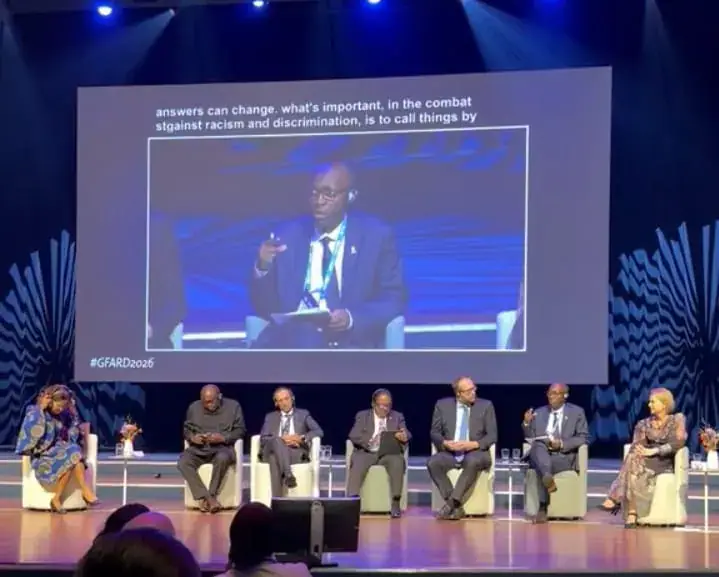
On October 29, 2026, in The Hague, Netherlands, Gabon's Minister of Justice, Augustin Emane, emphasized his country's dedication to combating racism and discrimination at the 5th Global Forum of the United Nations Educational, Scientific and Cultural Organization (UNESCO). The forum, which focused on the theme "From Commitment to Accountability: Changing the System, Changing the Future," brought together high-level representatives to discuss concrete actions to address these issues. Emane stressed the importance of moving beyond mere declarations of intent and instead implementing policies that prioritize transparency, evaluation, and tangible results.
During the discussions, Emane highlighted the varying perceptions of racism and discrimination across countries, shaped by unique historical, social, and cultural contexts. He encouraged participants to approach these issues with nuance, fostering dialogue, mutual understanding, and tailored solutions that account for national specificities. Furthermore, Emane emphasized that the justice system alone cannot resolve all problems related to discrimination, advocating for a comprehensive approach that engages all sectors of society, including public institutions, education, and social actors.
Emane provided an update on Gabon's situation, nearly three years after a significant national transformation. He outlined the country's ongoing reforms aimed at strengthening democratic institutions and enhancing security. These reforms seek to address social imbalances and promote equality. As part of these efforts, Gabon has established the Observatory of Inequalities, an instrument designed to help restore balance in the short, medium, and long term by analyzing disparities, collecting reliable data, and assessing the impact of public policies.
The Observatory of Inequalities will conduct a national survey in the coming months to create a comprehensive mapping of socioeconomic inequalities. This initiative aims to better understand the needs of vulnerable and indigenous populations, particularly in terms of access to citizenship, education, and justice. Emane also recalled that Gabon's constitution enshrines the principle of equality among all citizens, regardless of origin, race, sex, or religion, which serves as a foundation for social cohesion in a country with over 50 diverse communities.
In the area of prevention, Gabon has launched initiatives to combat hate speech and identity-based retreats. The national framework includes measures for prevention and repression, as well as the integration of modules aimed at deconstructing stereotypes into school curricula. This approach aligns with the International Decade for People of African Descent (2025-2034), which focuses on recognition, justice, and development to strengthen the fight against structural inequalities and historical injustices.
Emane concluded his intervention by urging participants to recognize the value of human diversity as a factor in bringing people together and building a more just and fraternal world. He reaffirmed Gabon's commitment to contributing to international efforts against racism and discrimination, emphasizing the country's readiness to collaborate with others to address these challenges.
The Gabonese minister's participation in the UNESCO forum underscores the country's proactive stance on combating racism and discrimination. By engaging in high-level discussions and sharing its experiences, Gabon aims to contribute meaningfully to the global conversation on these critical issues. Key initiatives, such as the Observatory of Inequalities and the integration of anti-stereotype modules in schools, demonstrate Gabon's commitment to practical action.
Key points
- Gabon's Justice Minister Augustin Emane reaffirms country's commitment to fighting racism and discrimination at UNESCO's 5th Global Forum.
- Gabon establishes Observatory of Inequalities to address social imbalances and promote equality.
- Gabon launches initiatives to combat hate speech and identity-based retreats as part of its national framework.