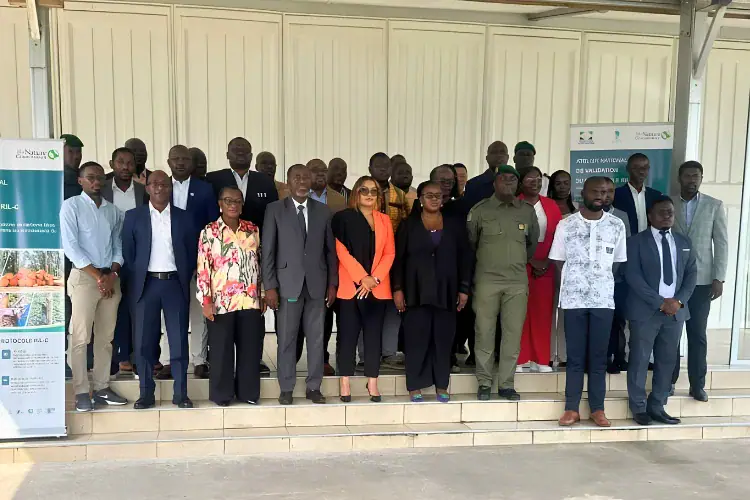
The Gabonese government recently convened a national workshop in Libreville to validate a protocol for integrating reduced-impact logging practices to mitigate carbon emissions. The event, held on November 19-20, was organized by the Ministry of Water and Forests with support from The Nature Conservancy (TNC) and the Central African Forest Initiative (CAFI). The protocol aims to provide a tool for measuring and monitoring carbon emissions tailored to the realities of Gabon's forest concessions.
The workshop brought together various stakeholders to discuss the protocol's methodology and implementation. Secretary General of the Ministry of Water and Forests, Hervie Pongui, highlighted that forests cover nearly 88% of Gabon's territory, spanning 23.6 million hectares. The goal is to preserve this national forest heritage while promoting sustainable transformation of the forestry sector. Pongui emphasized that the protocol will enable the country to move from good intentions to precise and verifiable measurements of emission reductions.
The protocol's development is a collaborative effort, with TNC's Guy-Romuald Ekome describing it as a credible, robust, and context-specific tool. The first day of the workshop focused on presenting the protocol and its methodology, while discussions centered on emissions related to selective logging practices. These include road construction, logging track opening, log yard management, and damage caused by felling, which is a primary source of forest degradation.
On the second day, group discussions addressed biomass, data collection, and the measurement, reporting, and verification (MRV) system. The workshop concluded with 16 recommendations, including six that require reformulation. Key recommendations include determining the sampling unit size with operators, strengthening sampling device representativeness, harmonizing mapping methods, and developing secure digital tools.
According to Saint-Clair Ebaye Mpiga, a TNC expert, the workshop enabled the pre-validation of the document. The next step involves gathering input from partners within three weeks to produce a consolidated protocol. Pemphile Mboulou, study manager at the Forest Directorate, noted that the protocol will encourage operators to adopt best practices for sustainable management, balancing climate preservation and local value creation.
The development of this protocol is part of Gabon's efforts to enhance sustainable forest management and reduce carbon emissions. The country has made significant strides in preserving its forest cover, which is crucial for biodiversity conservation and climate regulation. The implementation of this protocol is expected to support Gabon's commitment to sustainable development and environmental protection.
The validation workshop marks a significant milestone in Gabon's journey towards sustainable forestry practices. With the protocol's implementation, the country aims to set a precedent for responsible forest management in the region. Key stakeholders will continue to collaborate to ensure the effective rollout of this initiative, which is critical for Gabon's environmental and economic future.
Key points
- The protocol aims to provide a tool for measuring and monitoring carbon emissions tailored to the realities of Gabon's forest concessions.