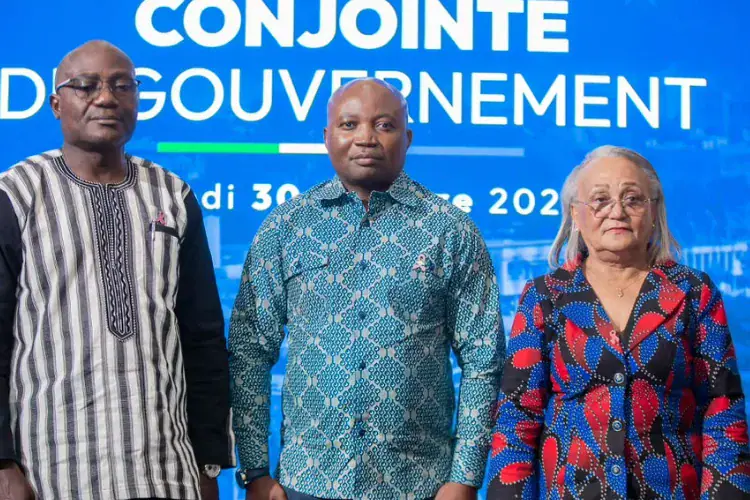
The Gabonese government has announced plans to begin demolishing several homes in Grand Libreville as part of a road expansion project. The demolitions are set to begin on November 4, and the government has assured affected families that measures are in place to support them. A joint press conference was held on October 30 in Libreville to outline the plans, which include compensation and relocation efforts. The project aims to improve traffic flow and modernize the capital's road infrastructure.
The road expansion project focuses on two strategic axes: Dispensaire d'Okala – sortie SEEG and Lac Bleu – Diba-Diba. According to Lambert Mouvinde Millot, Minister of Public Works and Construction, the project is necessary to improve circulation and modernize the capital's road infrastructure. Millot also announced that work on preparing plots for relocated families would begin on October 31. The National Agency for Urban Planning, Topographic Surveys, and Cadastre (ANUTTC) is responsible for identifying affected individuals, evaluating their properties, and determining relocation sites.
The ANUTTC, represented by Charles Léonard Nguema Ebozo'o, Director General Adjoint, has begun identifying affected individuals and evaluating their properties. The agency is also responsible for determining relocation sites, including Malibé and Ntoum. According to Nguema Ebozo'o, compensation efforts have already started and will continue. In addition to relocation, the government has addressed concerns about continuity of education for affected families. Jacqueline Iloguè épouse Bignoumba, Minister of National Education, assured that arrangements would be made for children to continue their education in nearby schools.
The government has also addressed concerns about supporting vulnerable individuals. Pepecy Ogouliguende, Secretary General of Social Affairs, reported that the ministry has identified individuals with disabilities, chronic illnesses, young mothers, and 150 households in precarious situations through social surveys and community outreach. The ministry plans to provide psychosocial and administrative support before, during, and after relocation. A forward post, set up with the Red Cross, will provide proximity assistance on the day of the operations.
The government's plan aims to balance urban modernization with protection of affected populations. With the first relocation operations approaching, it remains to be seen how these commitments will be implemented on the ground. Emmanuel Eyeghe Nze, government spokesperson, emphasized the government's commitment to supporting affected families. The project has been in the works for some time, with the government announcing plans to allocate 715 million for the first wave of compensations on October 29.
As the relocation operations approach, concerns have been raised about the potential impact on affected families. However, the government has assured that measures are in place to mitigate any negative effects. The project is expected to improve the overall quality of life for residents in Grand Libreville. The government's efforts to engage with affected families and provide support have been seen as a positive step towards minimizing the impact of the project.
The relocation operations are set to begin on November 4, with the government committed to providing support to affected families. The project is part of a larger effort to modernize and improve the infrastructure of Grand Libreville. The government's plan includes providing compensation, relocation assistance, and psychosocial support to affected individuals.
Key points
- The Gabonese government has outlined plans for the demolition of several homes in Grand Libreville as part of a road expansion project, with relocations set to begin November 4.
- The project aims to improve traffic flow and modernize the capital's road infrastructure, with two strategic axes being focused on: Dispensaire d'Okala – sortie SEEG and Lac Bleu – Diba-Diba.
- The government has assured affected families that measures are in place to support them, including compensation, relocation assistance, and psychosocial support.