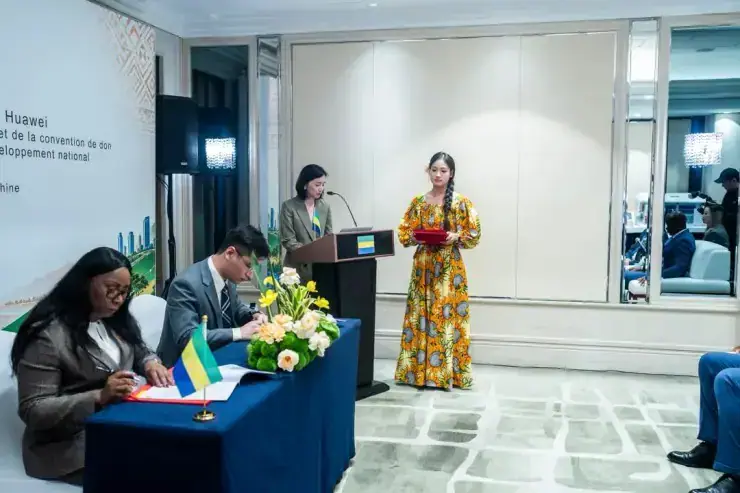
On Thursday, in Shanghai, Gabonese President Brice Clotaire Oligui Nguema presided over the signing of multiple partnership agreements aimed at accelerating Gabon's modernization and industrialization during his state visit to the People's Republic of China. The agreements cover various sectors, including public security, higher education, artificial intelligence, energy, and industrial infrastructure development.
In the technological domain, three memoranda of understanding were concluded with the Chinese group Huawei. These agreements focus on enhancing public security devices using intelligent technologies, digitalizing public universities, and equipping the Brice Clotaire Oligui Nguema University with pedagogical equipment dedicated to artificial intelligence. The goal is to improve public service quality, strengthen national competencies, and prepare Gabon's youth for future careers.
An letter of intent was signed between the Gabonese State, Eramet Comilog, and Sinohydro, a subsidiary of PowerChina, regarding the study of possibilities for electrical power supply to Eramet Comilog's future manganese alloys plant in the Libreville region. The Ngoulmendjim hydroelectric site is among the options being studied. This initiative builds on a memorandum of understanding signed on July 20, 2026, between the Gabonese State, Eramet, and Eramet Comilog, related to local manganese transformation.
The agreements also include partnerships for the integrated Belinga project, associating the Gabonese State with partner companies responsible for developing railway infrastructure, manufacturing wagons, and energy installations. These agreements complement the convention signed on April 23, 2026, with Africa Global Logistics (AGL) for the realization of the Kobe-Kobe deep-water port. The ceremony took place in the presence of representatives from local populations.
The realization of this set of infrastructures constitutes an important step for the exploitation of the Belinga iron deposit, the development of the national logistics chain, and the strengthening of the Gabonese economy. President Oligui Nguema aims to mobilize international partnerships around national priorities, including industrialization, local raw material transformation, infrastructure development, technology transfer, and job creation.
The effective implementation of these agreements is now a major challenge for their translation into concrete achievements for the benefit of the populations. According to the presidency, these partnerships aim to improve public service quality, strengthen national competencies, and prepare Gabon's youth for future careers. The Gabonese government will need to ensure the successful execution of these agreements.
The signing of these agreements demonstrates the commitment of both Gabon and China to strengthen bilateral cooperation and promote sustainable development in Gabon. The coming months will be crucial in determining the impact of these partnerships on Gabon's economy and society.
Key points
- The agreements focus on public security, higher education, artificial intelligence, energy, and industrial infrastructure development.
- The partnerships aim to improve public service quality, strengthen national competencies, and prepare Gabon's youth for future careers.
- The effective implementation of these agreements is now a major challenge for their translation into concrete achievements for the benefit of the populations.