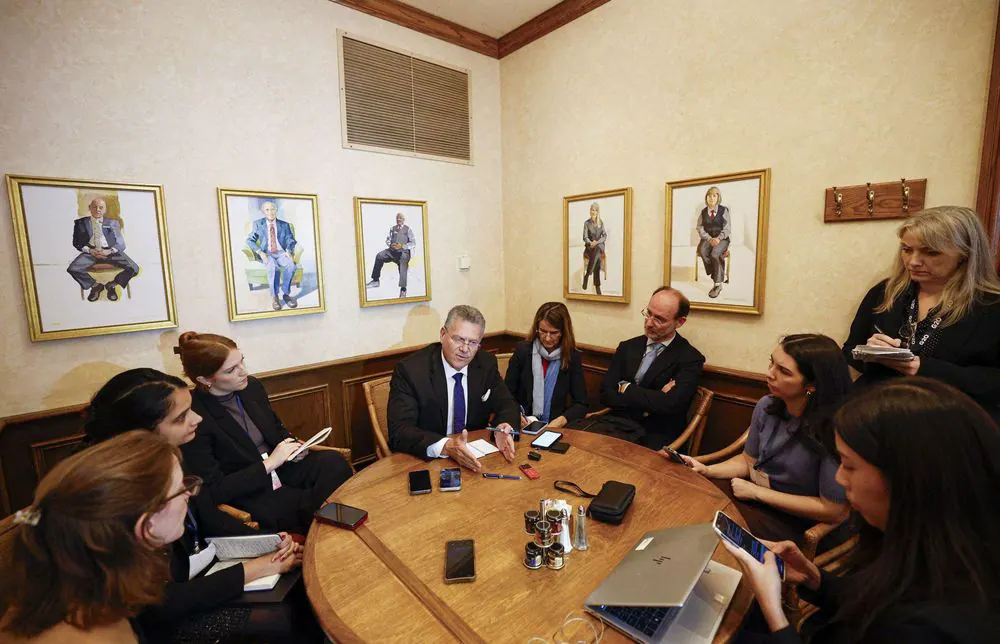
Trade ministers from the Group of 20 major economies met for a second day in Milwaukee, Wisconsin, but failed to find an agreement on overcapacity and eliminating forced labour in supply chains. US trade official Jamieson Greer stated that nearly all countries agreed that excess capacity is an issue that requires action, but no consensus was reached. The issue of overcapacity is often attributed to China, which rejects the criticism.
The US has launched investigations into 16 economies on overcapacity, targeting China, the European Union, Japan, India, and others. Greer warned that countries that overproduce risk creating an economy that rests on a house of cards. He also justified unilateral US action, citing the inadequacy of current trade remedies. The US has recently slapped tariffs on 60 trading partners over alleged forced labour concerns, another issue the G20 failed to reach an agreement on.
However, G20 countries did find consensus against the weaponisation of food through coercive trade actions. European officials criticised Russia's attacks on Ukraine's grain exports, which have impacted agricultural export capacity. France's minister delegate for international trade, Nicolas Forissier, stated that European leaders' comments against Russia's aggression on food exports merely constitute the truth.
Forissier added that the discussions at the G20 talks were quite constructive, and there is a consensus on the fact that it's not acceptable to weaponise food and agriculture. Russia's minister for economic development, Maxim Reshetnikov, criticised European leaders for speaking in political slogans. The G20 trade ministers are seeking to widen trade talks beyond their US host this week.
Canada is seeking bilateral trade deals with India, Turkey, Saudi Arabia, and the European Union on digital trade. Ottawa's minister for international trade, Maninder Sidhu, stated that Canada and India look forward to concluding negotiations in the coming months. Sidhu also met with Greer on the G20 sidelines to discuss further Canada-US cooperation.
A Mexican official stated that the country is making steady progress towards a US tariff deal, which would include reductions in steel, cars, and aluminium. However, Mexico is not looking to rush negotiations, and it is unclear if a deal will be struck before the US midterm elections. The G20 trade ministers' failure to reach an agreement on overcapacity and forced labour has raised concerns about the global economy.
The issue of overcapacity and forced labour in supply chains remains a major challenge for the global economy. The G20 trade ministers' meeting has highlighted the need for greater cooperation and agreement on these issues. The US and other countries are seeking to address these concerns through bilateral trade deals and other measures.
Key points
- G20 trade ministers fail to reach an agreement on overcapacity and forced labour in supply chains.
- The US has launched investigations into 16 economies on overcapacity, targeting China and others.
- The G20 countries find consensus against the weaponisation of food through coercive trade actions.