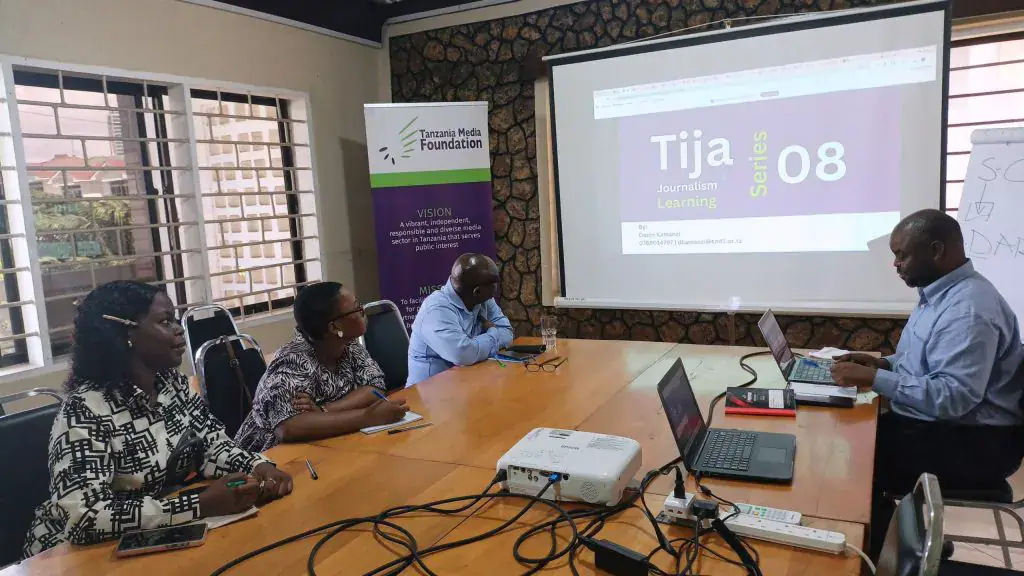
The Tanzania Media Foundation (TMF) recently hosted the Tija Journalism Learning Series 008, exploring the collaboration between human and artificial intelligence (HAI) in journalism. The session, facilitated by TMF Executive Director Dastan Kamanzi, aimed to help journalists understand how to combine machine capabilities with human intelligence to improve the quality and relevance of journalism. This initiative is part of TMF's efforts to strengthen impactful storytelling among local journalists.
Kamanzi emphasized that journalists should view artificial intelligence as an opportunity rather than a threat to their professional survival. He argued that human intelligence is superior and that the key is to combine it with artificial intelligence. Human intelligence has a capacity to hold 2.5 petabytes of data, equivalent to recording TV non-stop for 300 years. Kamanzi suggested that the real professional risk lies not in AI itself but in journalists who fail to understand and effectively use the emerging technology.
The session examined the distinctive capabilities of human and artificial intelligence, highlighting that neither should be treated as a complete substitute for the other. Human intelligence derives its strength from consciousness, lived experience, critical thinking, and emotional understanding, which are essential in journalism. Artificial intelligence, on the other hand, excels in processing large volumes of information, identifying patterns, and automating repetitive tasks.
Combining human and artificial intelligence can produce better journalism than relying exclusively on either. Kamanzi advised journalists to begin every assignment by identifying the intended product and then selecting the most appropriate tools to achieve the desired outcome. He emphasized that AI should serve the journalist's editorial purpose, rather than determine what journalism should become.
International media organizations are already incorporating AI into different stages of news production. According to the Reuters Institute for the Study of Journalism, publishers see AI as valuable in newsroom efficiency, content production, and investigative journalism. Practical applications of AI include research, transcription, translation, data journalism, and story development.
For rural journalists operating with limited resources, AI can be particularly beneficial. AI can help organize government reports, analyze statistics, and identify questions requiring further investigation. However, the resulting information must still be checked against original documents, independent experts, and people directly affected by the issues being reported.
The Association Press provides an important example of successful AI integration. Its newsroom has adopted AI-assisted processes for tasks such as transcription and headline suggestions while maintaining human editorial review. The updated newsroom standards reinforce the importance of editorial judgment, demonstrating that AI can enhance journalism without replacing human intelligence.
Key points
- Journalists should view artificial intelligence as an opportunity to improve their work rather than a threat to their professional survival.
- Combining human and artificial intelligence can produce better journalism than relying exclusively on either.
- AI should serve the journalist's editorial purpose, rather than determine what journalism should become.