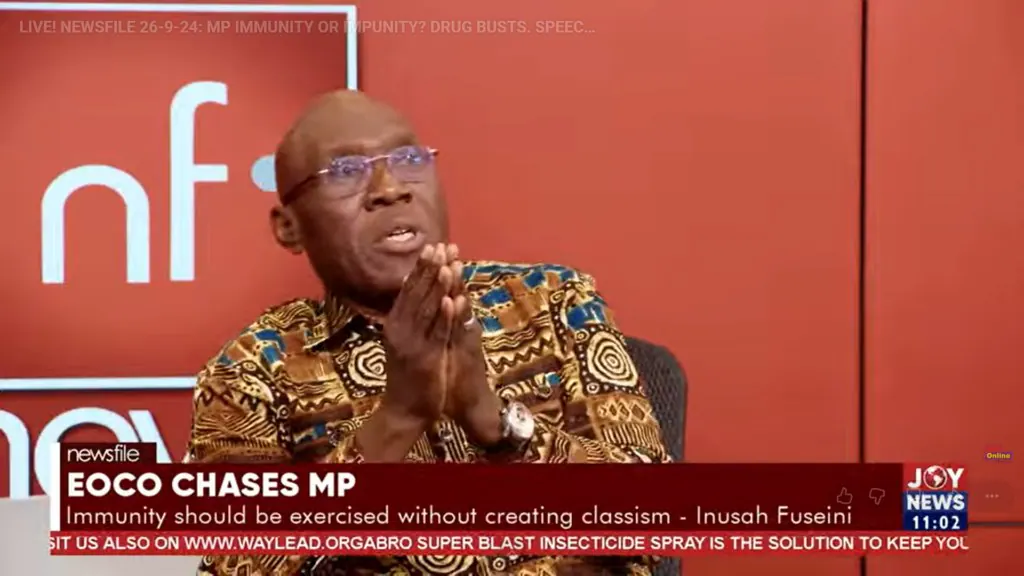
Former Tamale Central MP Inusah Fuseini has expressed scepticism about the Minority's call for a parliamentary inquiry into Ghana's cocaine trafficking scandal. He believes that Parliament cannot separate itself from partisan politics, making an impartial probe unlikely. Fuseini's comments come as the scandal deepens, with France seizing nearly 3.9 tonnes of cocaine at the port of Dunkirk, in a container traced back to Ghana. The seizure has triggered weeks of political finger-pointing, with MPs from both sides trading blame.
Fuseini argued that lawmakers have repeatedly failed to insulate themselves from partisan considerations whenever national issues are at stake. He does not expect the drug scandal to be any different. According to him, calling Parliament to investigate the matter would amount to a useless waste of time. Instead, he would rather see the country's intelligence agencies take up the probe. Fuseini made these comments on JoyNews' Newsfile on Saturday, 26 September 2026.
The Minority's push for a probe follows the parliamentary Speaker recalling MPs from their recess to sit on Tuesday, 30 September 2026. This move signals that the matter will be taken up in the House, despite Fuseini's misgivings. The Speaker's decision comes amid mounting controversy, including the disputed arrest of Manhyia South MP Baffour Awuah by the Economic and Organised Crime Office (EOCO).
Not everyone agrees with Fuseini's assessment, but some share his scepticism. Dr John Osae-Kwapong, a fellow at the Centre for Democratic Development (CDD-Ghana), also expressed doubts about the effectiveness of a parliamentary probe. He noted that Parliament has a history of raising issues without producing concrete outcomes. A probe into another institution is unlikely to break that pattern.
The Narcotics Control Commission (NACOC) has publicly conceded that its scanning oversight at the ports was inadequate, admitting it was 'useless'. An MP also claimed that early warnings had been ignored. NACOC disclosed that access to port scanning rooms is restricted to only Customs and MPS officials, raising questions about accountability at the point of export.
The standoff over who investigates the scandal matters because it determines whether the public gets a credible account of how nearly four tonnes of cocaine moved through the country's export system undetected. With NACOC's own oversight already called into question and EOCO's conduct disputed, the debate now centres on whether Parliament is the right body to get to the bottom of it.
Parliament is scheduled to reconvene on Tuesday, 30 September 2026, to discuss the matter. Beyond that sitting, no further timeline has been given for how any probe — whether by Parliament or another body — would proceed. The outcome will likely have significant implications for Ghana's efforts to tackle its cocaine trafficking problem.
Key points
- Former MP Inusah Fuseini questions Parliament's ability to conduct impartial probe into cocaine trafficking scandal
- The Narcotics Control Commission (NACOC) has conceded that its scanning oversight at the ports was inadequate
- Parliament is scheduled to reconvene on Tuesday, 30 September 2026, to discuss the matter