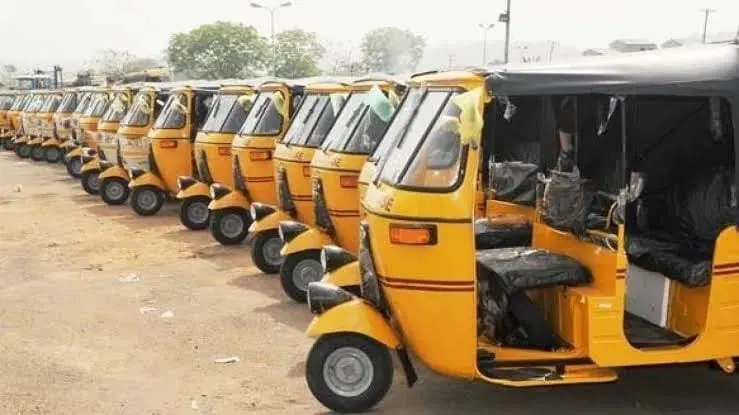
Commercial tricycle operators in the Federal Capital Territory (FCT) of Nigeria have increased fares on several routes following the recent rise in petrol prices. Petrol prices have surged to between N1,410 per litre and N1,450 per litre. This development has added to the financial pressure on commuters who are already facing rising transportation costs. The price increase is attributed to the global surge in crude oil prices, with Brent crude currently trading at $103.21 per barrel.
The fare adjustments were observed on various routes in Abuja, with some experiencing significant increases. For instance, the fare from Gudu to Lokogoma Junction has risen from N200 to N300, while the fare from Kabusa junction to Apo Roundabout has increased from N300 to N400. Similarly, the fare from Dutse express to Tipper Garage junction has risen from N400 to N500, and from Dutse express to Sokale roundabout, it has increased from N300 to N400. These changes have been implemented with little notice, forcing commuters to adjust their daily transportation budgets.
Tricycle operators cited the rising cost of petrol, higher maintenance costs, and spare-parts costs as reasons for the fare increase. Mr. Saidu Mohamed, a tricycle operator in Kubwa, mentioned that the increase in fuel prices has significantly impacted his operations. Another operator, Mr. Haruna Abdullahi, from Dutse, noted that he bought petrol at N1,430 per litre, which has added to the financial pressure on his business. Mr. Ibrahim Dauda, an operator in Kabusa, also attributed the fare increase to the high cost of petrol.
Commuters have expressed concerns about the impact of the fare increase on their daily lives. Mr. Daniel Aaron, a commuter in Kubwa, stated that the fuel price increase has made it difficult for him to move around and earn a living. Another commuter, Mr. Tony Akinbode, mentioned that he hardly goes out anymore due to the high cost of transportation, which has made it difficult for him to feed his family. Akinbode called on the Federal Government to intervene and stabilize fuel prices.
The fare increase has affected various routes across the FCT, with commuters paying more for daily journeys to workplaces, markets, schools, and other destinations. In Nyanya, the fare from Nyanya junction to City college is now N500. In Lugbe, the fare from Chika bridge has increased from N100 to N200, while the fare from Kubwa village junction to Byazhin is now N400. The new fares have been introduced with little notice, adding to the financial burden on commuters.
Public affairs analyst, Mr. Jide Ojo, expressed concern about the Federal Government's promotion of compressed natural gas (CNG) as an alternative to petrol. He noted that CNG infrastructure and distribution requirements differ from those of cooking gas and that motorists cannot obtain CNG in the same way they purchase petrol. Ojo suggested that the administration could do more to cushion the effect of price volatility while improving domestic crude supply, refining capacity, and access to alternative fuels.
The National Publicity Secretary of the Independent Petroleum Marketers Association of Nigeria (IPMAN), Chinedu Ukadike, stated that domestic petrol prices would continue to respond to changes in crude oil costs. He urged the Federal Government to consider supplying crude to domestic refineries at prices slightly below international market levels and to review some statutory charges affecting petroleum-product distribution. The latest adjustment in fuel prices has come amid broader increases in transportation costs, with commuters across the FCT continuing to contend with higher expenses associated with movement.
Key points
- The fare increase is attributed to the rising cost of petrol, with prices surging to between N1,410 per litre and N1,450 per litre.
- Commuters have expressed concerns about the impact of the fare increase on their daily lives, with some calling for government intervention.
- The Federal Government has been urged to consider alternative measures, such as promoting compressed natural gas (CNG) and improving domestic crude supply, to cushion the effect of price volatility.