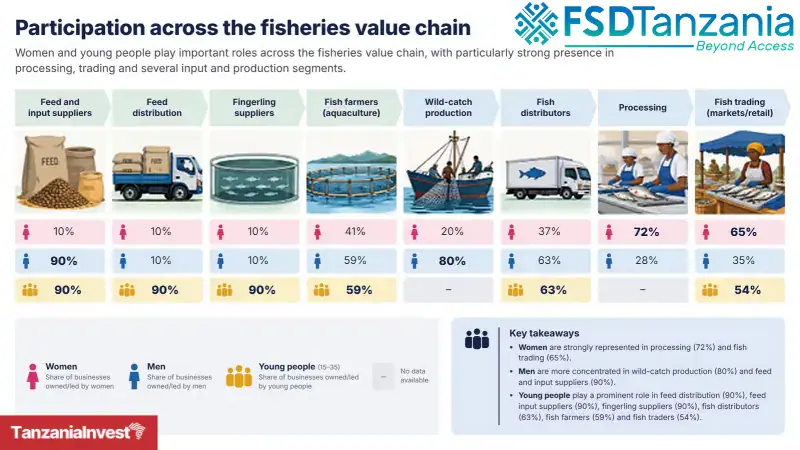
Tanzania's Financial Sector Deepening Trust (FSDT) has identified key steps to unlock finance for the country's fisheries value chain. According to a post published on 29 October 2026, 47% of surveyed fisheries operators have never borrowed. Despite this, the sector shows potential, with 91% of respondents saving and 82% keeping financial records. The post highlights that lenders need better data, shared risk, and new collateral options to engage with the sector.
The fisheries sector in Tanzania grew by 6.3% in 2025, up from 1.4% in 2024. The value of fish products rose by 4.6% from TZS 4.36 trillion to TZS 4.56 trillion. The fisheries value chain contributes 2.2% to the national GDP. The Fisheries Sector Master Plan 2021/22 to 2036/37 aims to increase this contribution to 10% by 2037. Achieving this target will require higher production, processing, exports, and investment.
Most participants in Tanzania's fisheries and aquaculture sector are micro, small, and medium enterprises (MSMEs). These businesses, including fishers, boat owners, and processors, own productive assets but serve established markets. However, finance rarely reaches them. FSDT attributes the lack of borrowing to limited borrower readiness, a mismatch between available financial products and fisheries needs, and the perceived risk of lending to the sector.
Many fisheries MSMEs have short or insufficient credit histories, making it harder for lenders to identify viable financing opportunities and assess risks. FSDT calls for better data and market intelligence, alternative data and credit-scoring models, and risk-sharing mechanisms. These measures would enable lenders to design suitable products and expand their engagement with the sector.
FSDT emphasizes the importance of financial literacy among MSMEs to support responsible borrowing and productive use of finance. The organization also stresses the need for accessible and affordable insurance. Bundling insurance with loans could improve affordability and uptake while protecting businesses against risk.
The recently passed Secured Transactions (Movable Property) Act 2026 allows equipment, vehicles, and inventory to be used as security for loans. The Act creates a Collateral Registry administered by the Bank of Tanzania (BoT). This registry will enable operators to use their assets to support loan applications. FSDT supported the Ministry of Finance in drafting the Act and is now working with the BoT to establish the registry.
FSDT is piloting an Alternative Credit Scoring Initiative in the Kilombero sugarcane value chain. The organization expects lessons from the pilot to be applicable to fisheries and other value chains. The FinScope MSME Tanzania 2026 Survey will provide demand-side data on MSMEs, including those operating in the fisheries value chain. This data will help inform future initiatives to support the sector.
Key points
- 47% of surveyed Tanzanian fisheries operators have never borrowed.
- The fisheries sector grew by 6.3% in 2025, up from 1.4% in 2024.
- The Fisheries Sector Master Plan aims to increase the sector's contribution to GDP to 10% by 2037.